
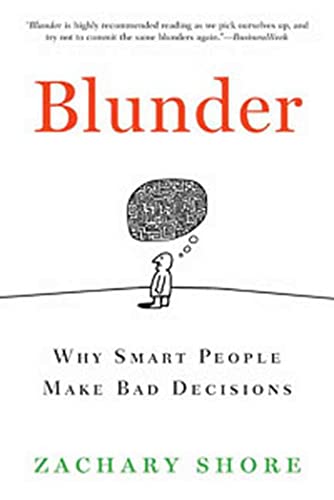
Blunder : why smart people make bad decisions / Zachary Shore.
Material type: TextPublication details: New York : Bloomsbury, 2009.Edition: 1st U.S. edDescription: vii, 260 p. ; 22 cmISBN:
 - 9781596916432
- Why smart people make bad decisions
- 153.8/3
- BF 448 S559b 2009
| Item type | Current library | Home library | Collection | Shelving location | Call number | Vol info | Copy number | Status | Barcode | |
|---|---|---|---|---|---|---|---|---|---|---|
 Libro
Libro
|
Biblioteca Juan Bosch | Biblioteca Juan Bosch | Humanidades | Humanidades (4to. Piso) | BF 448 S559b 2009 (Browse shelf(Opens below)) | 1 | 1 | Available | 00000080251 |
Browsing Biblioteca Juan Bosch shelves, Shelving location: Humanidades (4to. Piso), Collection: Humanidades Close shelf browser (Hides shelf browser)

|
No cover image available | No cover image available |

|

|

|

|
||
| BF 448 K93d 2018 The decision book : fifty models for strategic thinking / | BF 448 M987s 1974 Sobre la estupidez / | BF 448 S559b 2008 Blunder : why smart people make bad decisions / | BF 448 S559b 2009 Blunder : why smart people make bad decisions / | BF 449 I97t 2023 Think bigger : how to innovate / | BF 449 L518c 2005 Creatività e innovazione : [come nascono le nuove idee] / | BF 449 L666th 2014 Think like a freak : the authors of Freakonomics offer to retrain your brain / |
Includes bibliographical references (p. 237-251) and index.
We all make bad decisions. It's part of being human. The resulting mistakes can be valuable, the story goes, because we learn from them. But do we? Historian Zachary Shore says no, not always, and he has a long list of examples to prove his point. From colonialism to globalization, from gender wars to civil wars, or any circumstance for which our best solutions backfire, Shore demonstrates how rigid thinking can subtly lead us to undermine ourselves. In the process, he identifies seven "cognition traps" to avoid. But he also emphasizes how understanding these seven simple cognition traps can help us all make wiser judgments in our daily lives. For anyone whose best-laid plans have been foiled by faulty thinking, Blunder shines the penetrating spotlight of history on decision making and the patterns of thought that can lead us all astray.--From publisher description.
Introduction: Keeping current -- Exposure anxiety : the fear of being seen as weak -- Causefusion : confusing the causes of complex events -- Flatview : seeing the world in one dimension -- Cure-allism : believing that one size really fits all -- Infomania : the obsessive relationship to information -- Mirror imaging : thinking the other side thinks like us -- Static cling : refusal to accept a changing world -- Cognition trapped in Iraq -- Working toward wisdom.
There are no comments on this title.