
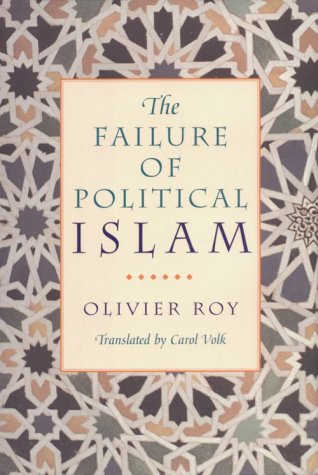
The failure of political Islam / Olivier Roy ; translated by Carol Volk.
Material type: TextLanguage: English Original language: French Publication details: Cambridge, Mass. : Harvard University Press, 1994.Description: xi, 238 p. ; 24 cmISBN:
 - 0674291409 (cloth : alk. paper) :
- Echec de l'islam politique. English
- 2 97
- BP 63 R888f 1994
| Item type | Current library | Home library | Collection | Shelving location | Call number | Vol info | Copy number | Status | Barcode | |
|---|---|---|---|---|---|---|---|---|---|---|
 Libro
Libro
|
Biblioteca Juan Bosch | Biblioteca Juan Bosch | Humanidades | Humanidades (4to. Piso) | BP 63 R888f 1994 (Browse shelf(Opens below)) | 1 | 1 | Available | 00000106674 |
Browsing Biblioteca Juan Bosch shelves, Shelving location: Humanidades (4to. Piso), Collection: Humanidades Close shelf browser (Hides shelf browser)

|

|

|

|

|

|

|
||
| BP 63 H668w 2002 War without end : the rise of Islamist terrorism and the global response / | BP 63 N157b 1999 Beyond belief : Islamic excursions among the converted peoples / | BP 63 P229m 2013 The Muslim brotherhood : from opposition to power / | BP 63 R888f 1994 The failure of political Islam / | BP 63 T672s 2011 The state of Islam : culture and Cold War politics in Pakistan / | BP 63.33 R382 2009 Religion and politics in Saudi Arabia : Wahhabism and the state / | BP 64 B167i 2003 Islam without fear : Egypt and the New Islamists / |
For many Westerners, ours seems to be the era of the "Islamic threat," with radical Muslims everywhere on the rise and on the march, remaking societies and altering the landscape of contemporary politics. In a powerful corrective to this view, the French political philosopher Olivier Roy presents an entirely different verdict: political Islam is a failure. Even if Islamic fundamentalists take power in countries like Algeria, they will be unable to reshape economics and politics and, in the name of "Islamic universalism," will express no more than nationalism or an even narrower agenda. Despite all the rhetoric about an "Islamic way," an "Islamic economy," and an "Islamic state," the realities of the Muslim world remain essentially unchanged. Roy demonstrates that the Islamism of today is still the Third Worldism of the 1960s: populist politics and mixed economies of laissez-faire for the rich and subsidies for the poor. In Roy's striking formulation, those marching today beneath Islam's green banners are the same as the "reds" of yesterday, with similarly dim prospects of success. Roy has much to say about the sociology of radical Islam, about the set of ideas and assumptions at its core. He explains lucidly why Iran, for all the sound and fury of its revolution, has been unable to launch "sister republics" beyond its borders, and why the dream of establishing Islam as a "third force" in international relations remains a futile one. Richly informed, powerfully argued, and clearly written, this is a book that no one trying to understand Islamic fundamentalism can afford to overlook.
Includes bibliographical references (p. 225-229) and index.
There are no comments on this title.