
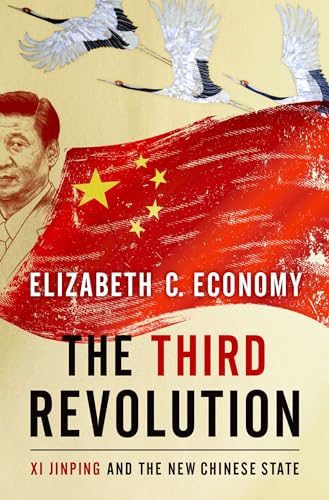
The third revolution : Xi Jinping and the new Chinese state / Elizabeth C. Economy.
Material type: TextLanguage: English Publisher: New York, NY : Oxford University Press, 2018Description: xiv, 343 pages : illustrations, maps ; 25 cmContent type:
 - text
- computer
- online resource
- 9780190866075
- 0190866071
- 951.06
- 408 DS 779.46 E19t 2018
| Item type | Current library | Home library | Collection | Shelving location | Call number | Copy number | Status | Barcode | |
|---|---|---|---|---|---|---|---|---|---|
 Libro
Libro
|
Biblioteca Juan Bosch | Biblioteca Juan Bosch | Recursos Regionales | Recursos Regionales (2do. Piso) | 408 DS 779.46 E19t 2018 (Browse shelf(Opens below)) | 1 | Available | 00000127356 |
Browsing Biblioteca Juan Bosch shelves, Shelving location: Recursos Regionales (2do. Piso), Collection: Recursos Regionales Close shelf browser (Hides shelf browser)

|

|

|

|

|

|

|
||
| 324 DG 77 B278r 1950 Los romanos / | 322 DA 320 S527 1999 Shakespeare's England : life in Elizabethan & Jacobean times / | 118 F 1938.4 H594P 2015 El presidente Heureaux y los gobiernos haitianos (1887-1899) / | 408 DS 779.46 E19t 2018 The third revolution : Xi Jinping and the new Chinese state / | 107 F 2849.22 G939Ca 1997 La vida en rojo : una biografía del Che Guevara / | 500 DT 28 P152s 1991 The scramble for Africa: white man's conquest of the dark continent from 1876 to 1912 / | 304 DB 36.3 J93h 2018 The Habsburg empire : a new history / |
"A Council on Foreign Relations Book."
Includes bibliographical references and index.
Chapter 1: Introduction -- Chapter 2: Heart of Darkness -- Chapter 3: Chinanet -- Chapter 4: The Not-So-New Normal -- Chapter 5: Innovation Nation -- Chapter 6: War on Pollution -- Chapter 7: The Lion Awakens -- Chapter 8: The Road Forward.
After three decades of reform and opening up, China is closing its doors, clamping down on Western influence in the economy, media, and civil society. At the same time, President Xi Jinping has positioned himself as a champion of globalization, projecting Chinese power abroad and seeking to reshape the global order. Herein lies the paradox of modern China--the rise of a more insular, yet more ambitious China that will have a profound impact on both the country's domestic politics and its international relations. In The Third Revolution, eminent China scholar Elizabeth C. Economy provides an incisive look at the world's most populous country. Inheriting a China burdened with slowing economic growth, rampant corruption, choking pollution, and a failing social welfare system, President Xi has reversed course, rejecting the liberalizing reforms of his predecessors. At home, the Chinese leadership has reasserted the role of the state into society and enhanced Party and state control. Beyond its borders, Beijing has recast itself as a great power and has maneuvered itself to be an arbiter--not just a player--on the world stage. Through an exploration of Xi Jinping's efforts to address top policy priorities--fighting corruption, controlling the internet, reforming state-owned enterprises, improving the country's innovation capacity, reducing the country's air pollution, and elevating its presence on the global stage--Economy identifies the tensions, shortcomings, and successes of Xi's first five years in office. Xi's ambition, she argues, provides new opportunities for the United States and the rest of the world to encourage greater Chinese contribution to global public goods but also necessitates a more proactive and coordinated effort to counter the rapidly expanding influence of an illiberal power within a liberal world order. This is essential reading for anyone interested in both China under Xi and how America and the world should deal with this vast nation in the coming years. "-- Provided by publisher.
"In The Third Revolution, eminent China scholar Elizabeth Economy provides an incisive look at the world's most populous country. Inheriting a China burdened with slowing economic growth, rampant corruption, choking pollution, and a failing social welfare system, President Xi has reversed course, rejecting the liberalizing reforms of his predecessors. At home, the Chinese leadership has reasserted the role of the state into society and enhanced Party and state control. Beyond its borders, Beijing has recast itself as a great power and has maneuvered itself to be an arbiter--not just a player--on the world stage. Through an exploration of Xi Jinping's efforts to address top policy priorities--fighting corruption, controlling the internet, reforming state-owned enterprises, improving the country's innovation capacity, reducing the country's air pollution, and elevating its presence on the global stage--Economy identifies the tensions, shortcomings, and successes of Xi's first five years in office. Xi's ambition, she argues, provides new opportunities for the United States and the rest of the world to encourage greater Chinese contribution to global public goods but also necessitates a more proactive and coordinated effort to counter the rapidly expanding influence of an illiberal power within a liberal world order. This is essential reading for anyone interested in both China under Xi and how America and the world should deal with this vast nation in the coming years"-- Provided by publisher.
Description based on print version record and CIP data provided by publisher; resource not viewed.
There are no comments on this title.