
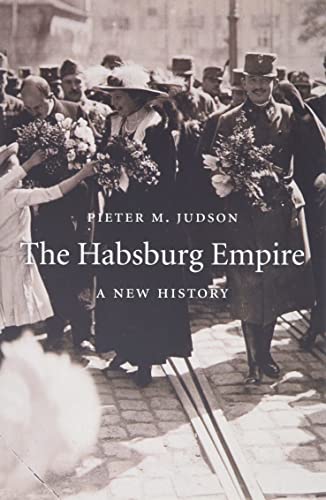
The Habsburg empire : a new history / Pieter M. Judson.
Material type: TextLanguage: English Publisher: Cambridge, Massachusetts ; London, England : The Belknap Press of Harvard University Press, 2018Description: xiii, 567 pages : illustrations, maps ; 25 cmContent type:
 - text
- unmediated
- volume
- 9780674986763
- 0674986768
- 943.6/04
- 304 DB 36.3 J93h 2018
| Item type | Current library | Home library | Collection | Shelving location | Call number | Copy number | Status | Barcode | |
|---|---|---|---|---|---|---|---|---|---|
 Libro
Libro
|
Biblioteca Juan Bosch | Biblioteca Juan Bosch | Recursos Regionales | Recursos Regionales (2do. Piso) | 304 DB 36.3 J93h 2018 (Browse shelf(Opens below)) | 1 | Available | 00000127372 |
Browsing Biblioteca Juan Bosch shelves, Shelving location: Recursos Regionales (2do. Piso), Collection: Recursos Regionales Close shelf browser (Hides shelf browser)

|

|

|

|

|

|

|
||
| 408 DS 779.46 E19t 2018 The third revolution : Xi Jinping and the new Chinese state / | 107 F 2849.22 G939Ca 1997 La vida en rojo : una biografía del Che Guevara / | 500 DT 28 P152s 1991 The scramble for Africa: white man's conquest of the dark continent from 1876 to 1912 / | 304 DB 36.3 J93h 2018 The Habsburg empire : a new history / | 500 DT 351 H624a 1983 Africa explored : Europeans in the Dark Continent, 1769-1889 / | 324 DG 311 O999r 2009 The ruin of the Roman Empire / | 117 F 1983 O77a 2006 Afropuertorriqueño(a) / |
Includes bibliographical references and index.
The accidental empire -- Servants and citizens, empire and fatherland, 1780-1815 -- An empire of contradictions, 1815-1848 -- Whose empire? the revolutions of 1848-1849 -- The emergence of a liberal empire -- Culture wars and wars for culture -- Everyday empire, our empire, 1880-1914 -- War and radical state building, 1914-1925.
"Moving beyond older approaches to the history of the Habsburgs in Central Europe in which nations are the main actors and nationalist conflict the inevitable moving force in the monarchy's trajectory, Pieter Judson offers an alternate narrative framework for the history of Habsburg Central Europe from the eighteenth century to the demise of the empire in World War I. He investigates how shared imperial institutions, administrative practices, and cultural programs helped to shape local society in every region of the empire. He shows how all of these elements gave imperial citizens fundamentally common experiences that crossed linguistic, confessional, and regional divides--experiences that even shaped nationalists' understandings of nationhood. And he traces what happened to the common or shared elements of imperial practice when the Habsburg monarchy formally ceased to exist in 1918."--Provided by publisher.
There are no comments on this title.