
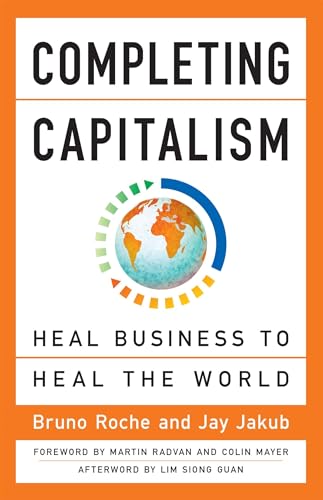
Completing capitalism : heal business to heal the world / Bruno Roche, Jay Jakub.
Material type: TextLanguage: English Publisher: Oakland, CA : Barrett-Koehler Publishers, a BK Business Book, 2017Edition: First EditionDescription: xi,184 pages ; 22 cmContent type:
 - text
- unmediated
- volume
- 9781626569270 (pbk.)
- 330.122
- HB 501 R673c 2017
| Item type | Current library | Home library | Collection | Shelving location | Call number | Copy number | Status | Barcode | |
|---|---|---|---|---|---|---|---|---|---|
 Libro
Libro
|
Biblioteca Juan Bosch | Biblioteca Juan Bosch | Ciencias Sociales | Ciencias Sociales (3er. Piso) | HB 501 R673c 2017 (Browse shelf(Opens below)) | 1 | Available | 00000122113 |
Foreword / by Colin Mayer, Former Dean, Oxford University's Saïd Business School, and Martin Radvan, Executive Vice President, Mars, Incorporated, and President, Mars Wrigley Global Confectionery --
Introduction : uprooting the dysfunctions of financial capitalism --
The expanded meaning of capital --
Five indicators for measuring human capital and well-being at work --
Measuring social capital; how communities affect growth --
Measuring natural capital; making more from less --
Recalibrating financial capital; how mutuality drives profits --
Maua; social and human capital : a case study --
Coffee; natural capital : a case study --
Remunerating the new forms of capital --
Conclusion : repositioning business as a restorative healing power --
Afterword / by Lim Siong Guan, Chairman, GIC; Singapore Sovereign Wealth Fund.
For the past fifty years, leaders in the business world have believed that their sole responsibility is to maximize profit for shareholders. But this obsessive focus was a major cause of the abuses that nearly sunk the global economy in 2008. In this analytically rigorous and eminently practical book, Bruno Roche and Jay Jakub offer a more complete form of capitalism, one that delivers superior financial performance precisely because it mobilizes and generates human, social, and natural capital along with financial capital. They describe how the model has been implemented in live business pilots in Africa, Asia, and elsewhere. Recent high-profile books like Capital in the Twenty-First Century have exposed financial capitalism’s shortcomings, but this book goes far beyond by describing a well-developed, field-tested alternative.
There are no comments on this title.