
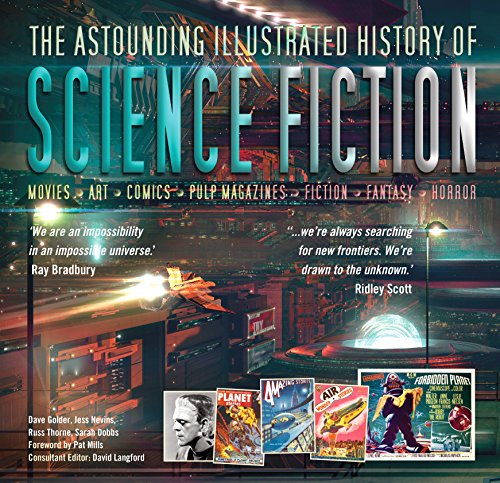
The astounding illustrated history of science fiction : movies, art, comics, pulp magazines, fiction / Dave Golder (Autor), Jess Nevins (Autor), Russ Thorne (Autor), Sarah Dobbs (Autor), David Langford (Consultor y Editor) y Pat Mills
Language: eng Publication details: London : Flame Tree Publishing, 2017Description: 191 pages : illustrations (chiefly colour) ; 29 x 30 cmISBN:- 9781786645272
- 1786645270
- PN 3433.5 A858 2017
| Item type | Current library | Home library | Collection | Shelving location | Call number | Copy number | Status | Barcode | |
|---|---|---|---|---|---|---|---|---|---|
 Libro
Libro
|
Biblioteca Juan Bosch | Biblioteca Juan Bosch | Humanidades | Humanidades (4to. Piso) | PN 3433.5 A858 2017 (Browse shelf(Opens below)) | 1 | Available | 00000164948 |
Foreword
Introduction
Science fiction unbound: pre-1500-1894
New frontiers: 1895-1925
The rise of the pulps: 1926-1942
A time of transition: 1943-1959
Reinventing the genre: 1960-1976
Back to the future: 1977-1989
The information age: 1990-2008
The future is now: 2009-2020
Key people
Further reading
Using timelines, online links, illustrations, posters, movie stills, book covers, and more, this book propels us into the well of modern imagination, from its roots in Frankenstein, through Verne, H.G. Wells, the late gothic and weird horror of Lovecraft to the mass market sensationalism of the Pulp magazines. The Pulps then invoked a new generation of writers (such as Ray Bradbury and Robert Bloch) of the Golden Age before many transitioned to screenwriting for the movies and early TV (Psycho, Star Trek, Twilight Zone), inspiring, in turn, the invasion of superheroes, gigantic spaceships, and dystopian landscapes onto our data-streaming tablets and computers. The book explores the interplay between great writers, (Asimov and Arthur C. Clarke) and story-telling directors (Kubrick, James Cameron, Ridley Scott, Christopher Nolan, George Lucas) who create powerful Sci-Fi, reflecting and challenging the developments of technology, science and society. Each have played a major role in this all-consuming, speculative form of world-building, from its early manifestation as a shocking literary event, to the mass market sensation is today
There are no comments on this title.