
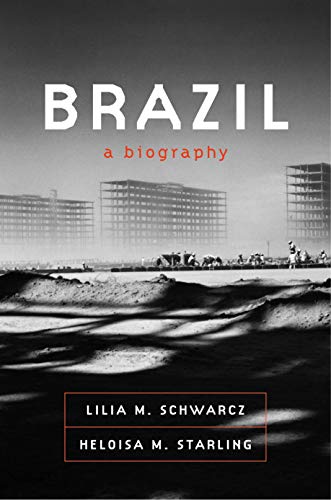
Brazil : a biography / Lilia M. Schwarcz and Heloisa M. Starling.
Material type: TextLanguage: English Original language: Portuguese Publisher: New York : Farrar, Straus and Giroux, 2018Edition: First American editionDescription: xxvi, 761 pages : illustrations, maps ; 24 cmContent type:
 - text
- unmediated
- volume
- 9780374280499 (hardcover)
- Brasil. English
- 981 23
- F2510 S399 2018
| Item type | Current library | Home library | Collection | Shelving location | Call number | Copy number | Status | Barcode | |
|---|---|---|---|---|---|---|---|---|---|
 Libro
Libro
|
Biblioteca Juan Bosch | Biblioteca Juan Bosch | Automatización y Procesos Técnicos | Automatización y Procesos Técnicos (1er. Piso) | F2510 S399 2018 (Browse shelf(Opens below)) | 1 | Available | 00000160146 |
Originally published: Brasil: uma Biografia : Companhia das Letras, Brazil, 2015.
Includes bibliographical references and index.
Introduction: "Brazil is just nearby" -- First came the name, and then the land called Brazil -- The sugar civilization: bitter for the many, sweet for a few -- Tit for tat: slavery and the naturalization of violence -- Gold! -- Revolt, conspiracy and sedition in the tropical paradise -- Ship ahoy! a court at sea -- Dom João and his court in the tropics -- The father leaves, the son remains -- Independence habemus: instability in the First empire -- Regencies, or the sound of silence -- The second reign: at last, a nation in the tropics -- The end of the monarchy in Brazil -- The first republic: the people take to the streets -- Samba, malandragem, authoritarianism: the birth of modern Brazil -- Yes, we have democracy! -- The 1950s and 1960s: bossa- nova, democracy and underdevelopment -- On a knife edge: dictatorship, opposition and resistance -- On the path to democracy: the transition to civilian power and the ambiguities and legacy of the military dictatorship -- Conclusion: history is not arithmetic.
Written by two leading historians, Brazil: A Biography is a sweeping and absorbing portrait of Brazil from its origins to the twenty-first century. For many Americans, Brazil is a land of contradictions: vast natural resources and entrenched corruption; extraordinary wealth and grinding poverty; beautiful beaches and violence-torn favelas. Brazile received more than 40 percent of the African population that was stolen from the continent, and was the last country in the Western world to abolish the slave system. Brazil is larger than the contiguous United States and occupies a vivid place in the American imagination, yet it remains largely unknown. In an extraordinary journey that spans more than five hundred years, from the Amerindian civilization to the 2016 Summer Olympics, Lilia M. Schwarcz and Heloisa M. Starling's Brazil offers a rich and dramatic history of this complex country. The authors not only reconstruct the epic story of the nation but follow the shifting byways of food, art, and popular culture; the plights of minorities; and the ups and downs of economic cycles. Drawing on a range of original scholarship in history, anthropology, political science, literature, and economics, Schwarcz and Starling reveal a long process of unfinished social, political, and economic progress and struggle, a story in which the troubled legacy of the mixing of races, postcolonial political dysfunction, and inequality persist to this day. Even now, Brazil stands as one of the world's great experiements - creative, harsh, unique, and as compelling a story for outsiders as for its inhabitants. -- From dust jacket
Translated from Portuguese.
There are no comments on this title.