
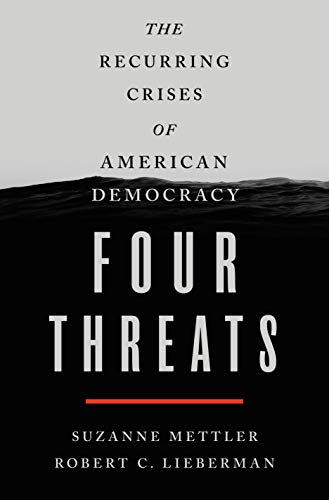
Four threats : the recurring crises of American democracy / Suzanne Mettler and Robert C. Lieberman.
Material type: TextLanguage: English Publisher: New York : St. Martin's Press, 2020Edition: First editionDescription: 298 pages : illustrations ; 25 cmContent type:
 - text
- unmediated
- volume
- 9781250244420 (hardcover)
- 1250244420 (hardcover)
- Democracy -- United States -- History
- Political culture -- United States -- History
- Polarization (Social sciences) -- United States
- Racism -- United States -- History
- Income distribution -- Political aspects -- United States
- Executive power -- United States -- History
- Democracia -- Estados Unidos
- Cultura política -- Estados Unidos
- Polarización (Ciencias sociales) -- Estados Unidos
- Racismo -- Historia -- Estados Unidos
- Distribución del ingreso -- Aspectos políticos -- Estados Unidos
- Poder ejecutivo -- Estados Unidos -- Historia
- United States -- Politics and government
- United States -- History
- Estados Unidos -- Política y gobierno
- Estados Unidos -- Historia
- 320.973
- JK 1726 M595f 2020
| Item type | Current library | Home library | Collection | Shelving location | Call number | Copy number | Status | Barcode | |
|---|---|---|---|---|---|---|---|---|---|
 Libro
Libro
|
Biblioteca Juan Bosch | Biblioteca Juan Bosch | Ciencias Sociales | Ciencias Sociales (3er. Piso) | JK 1726 M595f 2020 (Browse shelf(Opens below)) | 1 | Available | 00000163242 |
Includes bibliographical references and index.
Introduction: Democracy under siege -- Threats to democracy -- Polarization wreaks havoc in the 1790s -- Democratic disintegration in the 1850s -- Backsliding in the 1890s -- Executive aggrandizement in the 1930s -- The weaponized presidency in the 1970s -- At all costs : how the four threats endanger democracy -- Dangerous convergence -- Putting democracy first.
"An urgent, historically-grounded take on the four major factors that undermine American democracy, and what we can do to address them. While many Americans despair of the current state of U.S. politics, most assume that our system of government and democracy itself are invulnerable to decay. Yet when we examine the past, we find that the United States has undergone repeated crises of democracy, from the earliest days of the republic to the present. In Four Threats, Suzanne Mettler and Robert C. Lieberman explore five moments in history when democracy in the U.S. was under siege: the 1790s, the Civil War, the Gilded Age, the Depression, and Watergate. These episodes risked profound-even fatal-damage to the American democratic experiment. From this history, four distinct characteristics of disruption emerge. Political polarization, racism and nativism, economic inequality, and excessive executive power-alone or in combination-have threatened the survival of the republic, but it has survived-so far. What is unique, and alarming, about the present moment in American politics is that all four conditions exist. This convergence marks the contemporary era as a grave moment for democracy. But history provides a valuable repository from which we can draw lessons about how democracy was eventually strengthened-or weakened-in the past. By revisiting how earlier generations of Americans faced threats to the principles enshrined in the Constitution, we can see the promise and the peril that have led us to today and chart a path toward repairing our civic fabric and renewing democracy"-- Provided by publisher.
There are no comments on this title.