
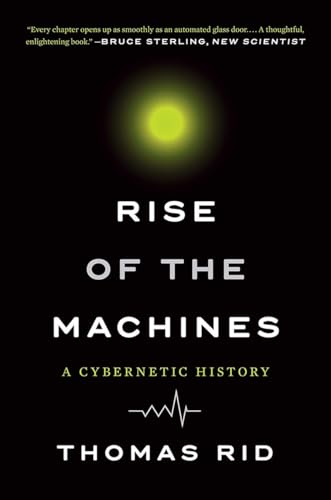
Rise of the machines : a cybernetic history / Thomas Rid.
Language: eng Publication details: New York : W.W. Norton & Company, 2017.Description: 414 pages : illustration ; 21 cmISBN:- 9780393354959 (pbk)
- T 14.5 R542r 2016
| Item type | Current library | Home library | Collection | Shelving location | Call number | Copy number | Status | Barcode | |
|---|---|---|---|---|---|---|---|---|---|
 Libro
Libro
|
Biblioteca Juan Bosch | Biblioteca Juan Bosch | Humanidades | Humanidades (4to. Piso) | T 14.5 R542r 2016 (Browse shelf(Opens below)) | 1 | Available | 00000174481 |
Control and communication at war --
Cybernetics --
Automation --
Organisms --
Culture --
Space --
Anarchy --
War --
Fall of the machines.
Springing from the febrile mind of mathematician Norbert Wiener amid the devastation of World War II, the cybernetic vision underpinned a host of seductive myths about the future of machines. This vision would radically transform the postwar world, ushering in sweeping cultural change. From the Cold War's monumental SAGE bomber defense system to enhanced humans, Wiener's scheme turned computers from machines of assured destruction into engines of brilliant utopias. Cybernetics triggered blissful cults, the Whole Earth Catalog, and feminist manifestos, just as it fueled martial gizmos and the air force's foray into virtual space. As Rid shows, Cybernetics proved a powerful tool for two competing factions-- those who sought to make a better world and those who sought to control the one at hand. In the Bay Area, techno-libertarians embraced networked machines as the portal to a new electronic frontier: a peaceful, open space of freedom. In Washington, DC, cyberspace provided the perfect theater for dominance and war. Meanwhile the future arrived secretly in 1996, with Moonlight Maze, dawn of a new age of digital state-on-state espionage. That "first cyberwar" ... went on for years-- and indeed has never stopped. In our long-promised cybernetic future, the line between utopia and dystopia continues to be disturbingly thin
There are no comments on this title.