
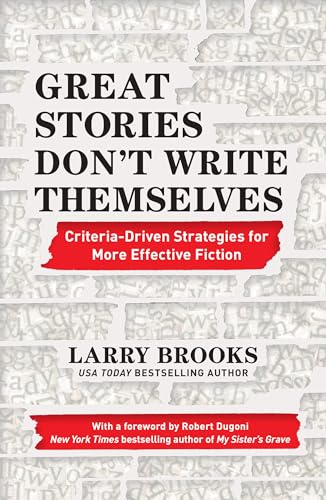
Great stories don't write themselves : criteria-driven strategies for more effective fiction / Larry Brooks.
Material type: TextLanguage: English Publisher: [Cincinnati, OH] : Writer's Digest Books, 2019Edition: First editionDescription: 250 pages : illustrations ; 22 cmContent type:
 - text
- unmediated
- volume
- 9781440300851 paperback
- 1440300852 paperback
- Great stories do not write themselves
- 808.3
- PN 3355 B873g 2019
| Item type | Current library | Home library | Collection | Shelving location | Call number | Copy number | Status | Barcode | |
|---|---|---|---|---|---|---|---|---|---|
 Libro
Libro
|
Biblioteca Juan Bosch | Biblioteca Juan Bosch | Humanidades | Humanidades (4to. Piso) | PN 3355 B873g 2019 (Browse shelf(Opens below)) | 1 | Available | 00000177433 |
Includes index.
Place of publication from publisher's website.
Part I: It's all in your head
1.The Mission of the Novel, and the Novelist
2.Developing a Criteria-Driven Nose for Story
3.What Happens When You Know
4.The Sound of the Writing Conversation
5.Realities, Odds, and Other Inconveniences
6.The Power of Storytelling Context
Part II. Navigating the leap from story idea to premise
7.The Eight Criteria for Premise
8.The Mission of Your Story Idea
9.The Idea-Fueled Premise
10.The Criteria for Concept
11.Context for Criteria-Driven Drafting
Part III: Criteria for the parts and parcel of story development
12.The Functional Mission of Story Structure
13.Contextual Application of the Four Quartiles
14.Structure-Enabled Characterization
15.Criteria for the Part 1 Set-Up Quartile
16.Criteria for the First Plot Point
17.Criteria for the Part 2 Hero's Response
18.Criteria for the Mid-Block Pinch Points
19.Criteria for the Midpoint
20.Criteria for the Part 3 Hero's Attack
21.Criteria for the Second Plot Point
22.Criteria for the Part 4 Resolution
Part IV: The sum of the parts
23.Criteria for Effective Scenes
24.Criteria for Professional Narrative Prose
25.Caveats, Exceptions, Contradictions
One of the most common questions new writers ask professional writers is about how the author wrote their book, what was their process for storytelling? But really the question should be about the general principles and nature of story--does every part of a story have what it needs to keep readers turning the pages (regardless of how the author got there)? Does every scene, every part of the story support the strategic narrative objective of providing new information a scene will inject in the story (the key principle of writing fiction)? Larry Brooks has developed a series of detailed checklists backed by tutorial content for novelists of every level and genre to refer to as they write regardless of which writing method they prefer. Beginning with the broadest part of story, the early checklists help writers to ensure that their book is based on a premise (aka plot) rather than an idea, or how you can elevate your idea into an actual premise where other story elements can be developed. Gradually honing in on other story elements like hero empathy, dramatic tension, thematic richness, vicariousness of story, narrative strategy, scene construction, etc. each with their own checklists with specific, actionable items that ensure that key principle (providing information to move the story forward) occurs
There are no comments on this title.