
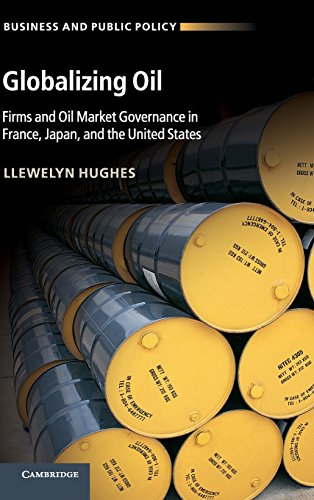
Globalizing oil : firms and oil market governance in France, Japan, and the United States / Llewelyn Hughes.
Material type: TextLanguage: English Series: Business and public policy | Business and public policyPublisher: Cambridge ; New York : Cambridge University Press, 2014Description: xi, 254 pages : illustrations ; 24 cmContent type:
 - text
- unmediated
- volume
- 9781107041998
- 1107041996
- 338.2/7282
- HD 9560.6 H893g 2014
| Item type | Current library | Home library | Collection | Shelving location | Call number | Copy number | Status | Barcode | |
|---|---|---|---|---|---|---|---|---|---|
 Libro
Libro
|
Biblioteca Juan Bosch | Biblioteca Juan Bosch | Ciencias Sociales | Ciencias Sociales (3er. Piso) | HD 9560.6 H893g 2014 (Browse shelf(Opens below)) | 1 | Available | 00000177504 |
Includes bibliographical references and index.
Preface; 1. The puzzle of oil; 2. Oil markets and the physiocratic fallacy; 3. Explaining changes in oil market governance; 4. Transforming French oil market governance; 5. Adjusting oil market governance in Japan; 6. The United States and energy independence; 7. Firms, governments, and oil market governance; Appendix A. Liberalization in the advanced industrialized states.
Oil is the world's most important commodity. It is also its most politicized. Yet in Globalizing Oil Llewelyn Hughes shows that since the 1970s governments across the advanced industrial states liberalized oil markets by freeing prices, lowering trade barriers, and privatizing national oil companies. How did this come about? And why do some governemnts continue to intervene in support of domestic firms? In answering these questions, Hughes shows that the transformation of the international oil market in the 1970s changed the risks and opportunities facing firms. He also shows their ability to benefit was conditioned by previous attempts to shape the competitive landscape. Changes in oil market governance in the 1980s and 1990s can thus be understood as a temporal process, in which institutional legacies affected firm sstrategies towards liberalization. Hughes' study has important implications not only for the politics of oil, but also for the study of economic liberalization.
There are no comments on this title.