
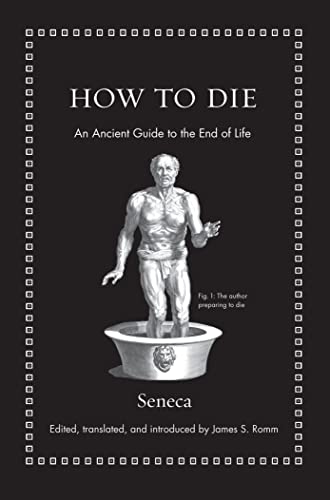
How to die : an ancient guide to the end of life / Séneca ; Edited, translated, and intriduced by James S. Romm.
Material type: TextLanguage: English Publisher: Princeton, NJ : Princeton University Press, 2018Description: xx, 230 pages ; 18 cmContent type:
 - text
- unmediated
- volume
- 9780691175577 (cloth : alk. paper)
- 0691175578 (cloth : alk. paper)
- BJ 1550 S475h 2018
| Item type | Current library | Home library | Collection | Shelving location | Call number | Copy number | Status | Barcode | |
|---|---|---|---|---|---|---|---|---|---|
 Libro
Libro
|
Biblioteca Juan Bosch | Biblioteca Juan Bosch | Humanidades | Humanidades (4to. Piso) | BJ 1550 S475h 2018 (Browse shelf(Opens below)) | 1 | Available | 00000128250 |
Introduction
How to die
Prepare yourself
Have no fear
Have no regrets
Set yourself free
Become a part of the whole
Epilogue: Practice what you preach (Tacitus, Annals15.61-64)
Latin texts
Notes
It takes an entire lifetime to learn how to die," wrote the Roman Stoic philosopher Seneca (c. 4 BC-65 AD). He counseled readers to "study death always," and took his own advice, returning to the subject again and again in all his writings, yet he never treated it in a complete work. How to Die gathers in one volume, for the first time, Seneca's remarkable meditations on death and dying. Edited and translated by James S. Romm, How to Die reveals a provocative thinker and dazzling writer who speaks with a startling frankness about the need to accept death or even, under certain conditions, to seek it out. Seneca believed that life is only a journey toward death and that one must rehearse for death throughout life. Here, he tells us how to practice for death, how to die well, and how to understand the role of a good death in a good life. He stresses the universality of death, its importance as life's final rite of passage, and its ability to liberate us from pain, slavery, or political oppression. Featuring beautifully rendered new translations, How to Die also includes an enlightening introduction, notes, the original Latin texts, and an epilogue presenting Tacitus's description of Seneca's grim suicide.
There are no comments on this title.