
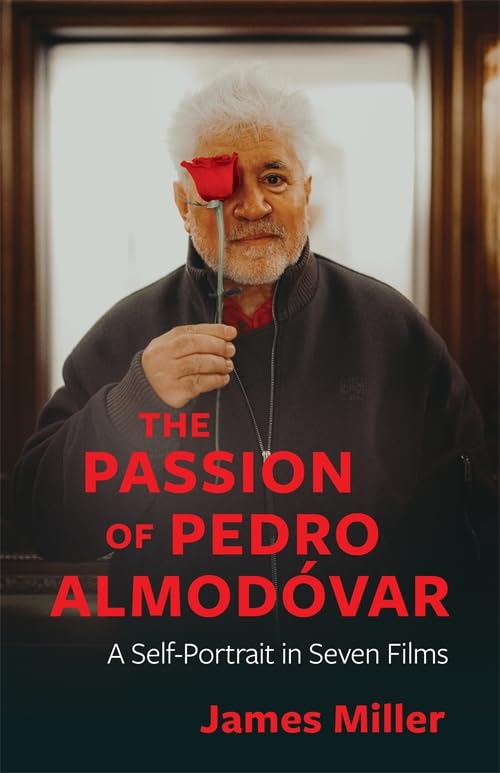
The passion of Pedro Almodóvar : a self-portrait in seven films / James Miller.
Material type: TextLanguage: English Publisher: New York : Columbia University Press, [2025]Description: xi, 204 pages ; 23 cmContent type:
 - text
- unmediated
- volume
- 9780231220040
- 791.43/75 23/eng/20250209
- PN1998.3.A46 M55 2025
| Item type | Current library | Home library | Collection | Shelving location | Call number | Copy number | Status | Barcode | |
|---|---|---|---|---|---|---|---|---|---|
 Libro
Libro
|
Biblioteca Juan Bosch | Biblioteca Juan Bosch | Automatización y Procesos Técnicos | Automatización y Procesos Técnicos (1er. Piso) | PN1998.3.A46 M55 2025 (Browse shelf(Opens below)) | 1 | Available | 00000194764 |
Includes bibliographical references and index.
Volver -- Bad education -- Pepi, Luci, Bom and other girls on the heap -- The law of desire -- The flower of my secret -- Broken embraces -- Pain and glory -- Coda : Once upon a time in the counterculture.
"James Miller became interested in Almodóvar when he realized that, like the author, he was a man of the Sixties, forged in that decade's global counterculture, and seriously pursuing his own quest for personal liberation; both author and filmmaker are fascinated with philosophy as a way of life and investigating key questions about the human condition. The Passion of Pedro Almódovar argues that the director's vision of freedom is rooted in surrealism, the philosophy of Sartre, and in a desire-oriented theory of wellbeing based on Jean Cocteau's theory of the ""surreal sex of beauty,"" which posited a third gender between the binary forms. Almodóvar is arguably the most important artist with a self-conscious interest in moral philosophy to have emerged from the global counterculture of the 1960s. His films, if taken in sequence, amount to a sustained struggle to understand, in his terms, the limits of moral autonomy and of nihilism and egotism. Like no other filmmaker before him, a generous interpretation of his oeuvre becomes increasingly difficult if one simply takes each movie as a freestanding entertainment rather than another chapter in the director's episodic and often revealing self-portrait. Collectively they provide an ongoing series of fictional alter egos, telling and retelling essential episodes in the story of his life, thinking about the past in the spirit of Proust but exploring the alternative lives he might have lived in the style of Pessoa, in this way learning more about who he is and what he might yet become. Espousing Whitman's "I contain multitudes," what may present superficially as sensationally beautiful storytelling turns out to communicate something simpler and more profound: one man's philosophy of life and the anguish behind his ongoing search for meaning."-- Provided by publisher.
There are no comments on this title.