
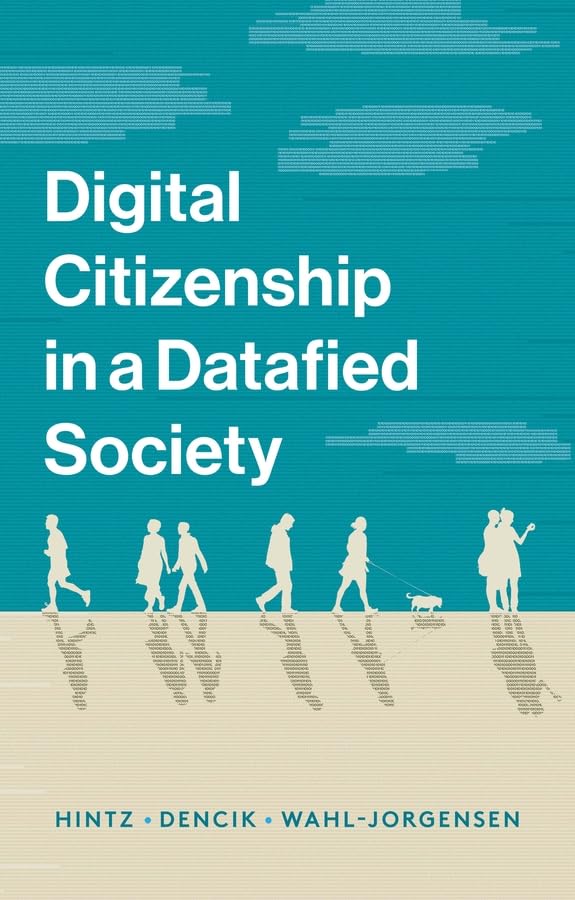
Digital citizenship in a datafied society / Arne Hintz, Lina Dencik and Karin Wahl-Jorgensen.
Material type: TextLanguage: English Publisher: Cambridge, UK ; Medford, MA : Polity Press, 2019Description: vii, 194 pages ; 22 cmContent type:
 - text
- unmediated
- volume
- 9781509527151
- 9781509527168
- 323/.04202854678 23
- JF1525.A8 H666d 2019
| Item type | Current library | Home library | Collection | Shelving location | Call number | Copy number | Status | Barcode | |
|---|---|---|---|---|---|---|---|---|---|
 Libro
Libro
|
Biblioteca Juan Bosch | Biblioteca Juan Bosch | Automatización y Procesos Técnicos | Automatización y Procesos Técnicos (1er. Piso) | JF1525.A8 H666d 2019 (Browse shelf(Opens below)) | 1 | Available | 00000198137 |
Includes bibliographical references and index.
Acknowledgements -- Introduction: citizens, data and surveillance -- Citizenship in a digital age -- Datafication and surveillance -- Regulating datafication -- Mediating digital citizenship -- Understanding and negotiating digital environments -- Challenging datafication -- Conclusion: enabling digital citizenship in a datafied society -- Notes -- References -- Index.
Digital Citizenship in a Datafied Society explores how the rapid growth of digital technologies and the pervasive collection and use of personal data are reshaping the idea of citizenship. The authors argue that traditional and even contemporary concepts of digital citizenship—which often focus on participation, rights, and empowerment online—are no longer sufficient in a world where citizens are continuously monitored, categorized, and profiled by both state and corporate data systems.
Drawing on extensive empirical research, the book examines how datafication and surveillance influence citizens’ roles and agency, the regulatory frameworks intended to manage data practices, how digital citizenship is represented and mediated in public discourse, and how ordinary people understand and negotiate their digital environments.
It also looks at possibilities for resistance and dissent, suggesting that citizens need not just digital skills but also critical awareness of how data systems work and shape power relations. The authors propose that a more just and democratic form of digital citizenship must acknowledge these data-driven processes and the social forces that shape them, moving beyond individual responsibility toward collective and structural responses.
In short: the book reframes digital citizenship for the data age, highlighting both opportunities for civic engagement and the serious challenges posed by surveillance and data-based governance.
There are no comments on this title.