
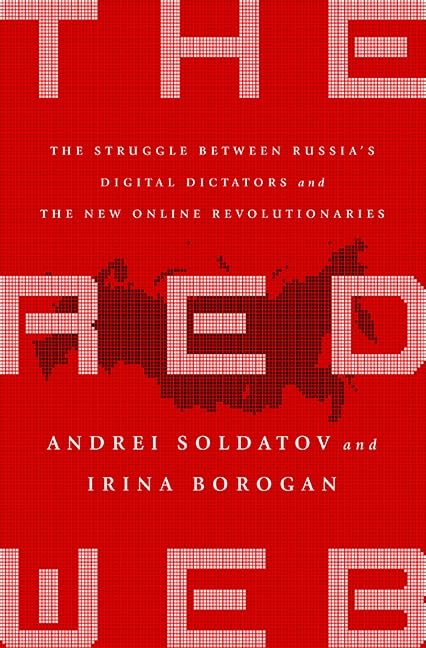
The red web : the struggle between Russia's digital dictators and the new online revolutionaries / Andrei Soldatov and Irina Borogan.
Material type: TextLanguage: English Publisher: New York : PublicAffairs, 2015Edition: First editionDescription: xi, 370 pages ; 25 cmContent type:
 - text
- unmediated
- volume
- 9781610395731 (hardcover)
- 1610395735 (hardcover)
- Internet -- Political aspects -- Russia (Federation)
- Information society -- Political aspects -- Russia (Federation)
- Internet -- Access control -- Russia (Federation)
- Electronic surveillance -- Russia (Federation)
- Freedom of information -- Russia (Federation)
- Internet -- Aspectos políticos -- Rusia (Federación)
- Sociedad de la información -- Aspectos políticos -- Rusia (Federación)
- Internet -- Control de acceso -- Rusia (Federación)
- Vigilancia electrónica -- Rusia (Federación)
- Libertad de información -- Rusia (Federación)
- Russia (Federation) -- Politics and government -- 1991-
- Rusia (Federación) -- Política y gobierno -- 1991-
- 303.48/330947
- JN 6695 S684r 2015
| Item type | Current library | Home library | Collection | Shelving location | Call number | Copy number | Status | Barcode | |
|---|---|---|---|---|---|---|---|---|---|
 Libro
Libro
|
Biblioteca Juan Bosch | Biblioteca Juan Bosch | Ciencias Sociales | Ciencias Sociales (3er. Piso) | JN 6695 S684r 2015 (Browse shelf(Opens below)) | 1 | Available | 00000193721 |
Includes bibliographical references and index.
The prison of information
The first connection
Merlin's tower
The black box
The coming of Putin
Internet rising
Revolt of the wired
Putin strikes back
"We just come up with the hardware"
The Snowden affair
Putin's overseas offensive
Watch your back
The big red button
Moscow's long shadow
Information runs free
On the eighth floor of an ordinary-looking building in an otherwise residential district of southwest Moscow, in a room occupied by the Federal Security Service (FSB), is a box the size of a VHS player marked SORM. The Russian government's front line in the battle for the future of the Internet, SORM is the world's most intrusive listening device, monitoring e-mails, Internet usage, Skype, and all social networks. But for every hacker subcontracted by the FSB to interfere with Russia's antagonists abroad -- such as those who, in a massive denial-of-service attack, overwhelmed the entire Internet in neighboring Estonia -- there is a radical or an opportunist who is using the web to chip away at the power of the state at home. Drawing from scores of interviews personally conducted with numerous prominent officials in the Ministry of Communications and web-savvy activists challenging the state, Andrei Soldatov and Irina Borogan peel back the history of advanced surveillance systems in Russia. From research laboratories in Soviet-era labor camps, to the legalization of government monitoring of all telephone and Internet communications in the 1990s, to the present day, their investigation into the Kremlin's massive online-surveillance state exposes just how easily a free global exchange can be coerced into becoming a tool of repression and geopolitical warfare
There are no comments on this title.