
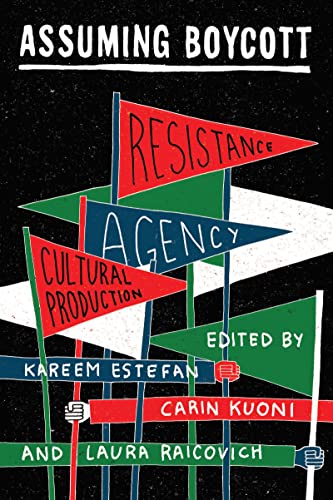
Assuming boycott : resistance, agency, and cultural production / edited by Kareem Estefan, Carin Kuoni, and Laura Raicovich.
Material type: TextLanguage: English Publisher: New York : OR Books, 2017Description: 273 pages ; 21 cmContent type:
 - text
- unmediated
- volume
- 9781944869434 (paperback)
- 1944869433 (paperback)
- 9781682190920
- 1682190927
- 1682190927
- 327.117
- HF 1413.5 A851 2017
| Item type | Current library | Home library | Collection | Shelving location | Call number | Copy number | Status | Barcode | |
|---|---|---|---|---|---|---|---|---|---|
 Libro
Libro
|
Biblioteca Juan Bosch | Biblioteca Juan Bosch | Ciencias Sociales | Ciencias Sociales (3er. Piso) | HF 1413.5 A851 2017 (Browse shelf(Opens below)) | 1 | Available | 00000124548 |
Includes bibliographical references (pages 243-267) and index.
Introduction by Kareem EstefanI. The Cultural Boycott of Apartheid South AfricaSean Jacobs, The Legacy of the Cultural Boycott Against South AfricaJohn Peffer, Art, Resistance, and Community in 1980s South AfricaHlonipha Mokoena, Kwaito: The Revolution Was Not Televised; It Announced Itself in SongFrank B. Wilderson III, Incognegro: A Memoir of Exile and Apartheid (excerpt)II. BDS and the Cultural Boycott of IsraelAriella Azoulay, “We,” Palestinians and Jewish Israelis: The Right Not to Be a PerpetratorNoura Erakat, The Case for BDS and the Path to Co-ResistanceEyal Weizman and Kareem Estefan, Extending Co-ResistanceNasser Abourahme, Boycott, Decolonization, Return: BDS and the Limits of Political SolidarityJoshua Simon, Neoliberal Politics, Protective Edge, and BDSYazan Khalili, The Utopian ConflictIII. Who Speaks? Who Is Silenced?Tania Bruguera, The Shifting Grounds of Censorship and Freedom of Expression, from Cuba to IsraelNaeem Mohaiemen, The Loneliness of the Long-Distance CampaignSvetlana Mintcheva, Structures of Power and the Ethical Limits of SpeechAnn Laura Stoler, By Colonial Design: Or, Why We Say We Don’t Know EnoughIV. Dis/engagement From AfarChelsea Haines, The Distant ImageMariam Ghani with Haig Aivazian, 52 Weeks, and Engaging by DisengagingNathan Gray and Ahmet Öğüt, Not Walking Away: Participation and Withdrawal in the 2014 Sydney BiennialRadhika Subramaniam, Loose Connection
Boycott and divestment are essential tools for activists around the globe. Todays organizers target museums, universities, corporations, and governments to curtail unethical sources of profit, discriminatory practices, or human rights violations. They leverage cultural production and challenge its institutional supports helping transform situations in the name of social justice. The refusal to participate in an oppressive system has long been one of the most powerful weapons in the organizers arsenal. Since the days of the 19th century Irish land wars, when Irish tenant farmers defied the actions of Captain Charles Boycott and English landlords, "boycott" has been a method thats shown its effectiveness time and again. In the 20th century, it notably played central roles in the liberation of India and South Africa and the struggle for civil rights in the U.S.: the 1955 Montgomery bus boycott is generally seen as a turning point in the movement against segregation. Assuming Boycott is the essential reader for todays creative leaders and cultural practitioners, including original contributions by artists, scholars, activists, critics, curators and writers who examine the historical precedent of South Africa; the current cultural boycott of Israel; freedom of speech and self-censorship; and long distance activism. Far from withdrawal or cynicism, boycott emerges as a productive tool of creative and productive engagement. Including essays by Nasser Abourahme, Ariella Azoulay, Tania Bruguera, Noura Erakat, Kareem Estefan, Mariam Ghani with Haig Aivazian, Nathan Gray and Ahmet Öğüt, Chelsea Haines, Sean Jacobs, Yazan Khalili, Carin Kuoni and Laura Raicovich, Svetlana Mintcheva, Naeem Mohaiemen, Hlonipha Mokoena, John Peffer, Joshua Simon, Ann Laura Stoler, Radhika Subramaniam, Eyal Weizman and Kareem Estefan, and Frank B. Wilderson III.
There are no comments on this title.