
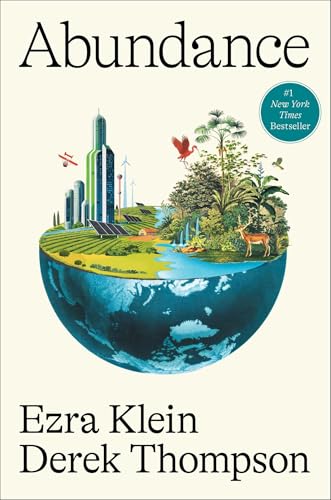
Abundance / Ezra Klein and Derek Thompson.
Material type: TextLanguage: English Publisher: New York : Avid Reader Press, 2025Edition: First Avid Reader Press hardcover editionDescription: ix, 288 pages ; 24 cmContent type:
 - text
- unmediated
- volume
- 9781668023488 (hardcover)
- 1668023482 (hardcover)
- HC 106.84 K64a 2025
| Item type | Current library | Home library | Collection | Shelving location | Call number | Copy number | Status | Barcode | |
|---|---|---|---|---|---|---|---|---|---|
 Libro
Libro
|
Biblioteca Juan Bosch | Biblioteca Juan Bosch | Ciencias Sociales | Ciencias Sociales (3er. Piso) | HC 106.84 K64a 2025 (Browse shelf(Opens below)) | 1 | Available | 00000194990 |
Includes bibliographical references (pages 227-272) and index.
To trace the history of the twenty-first century so far is to trace a history of unaffordability and shortage. After years of refusing to build sufficient housing, America has a national housing crisis. After years of limiting immigration, we don't have enough workers. Despite decades of being warned about the consequences of climate change, we haven't built anything close to the clean-energy infrastructure we need. Ambitious public projects are finished late and over budget--if they are ever finished at all. The crisis that's clicking into focus now has been building for decades--because we haven't been building enough. Abundance explains that our problems today are not the results of yesteryear's villains. Rather, one generation's solutions have become the next generation's problems. Rules and regulations designed to solve the problems of the 1970s often prevent urban-density and green-energy projects that would help solve the problems of the 2020s. Laws meant to ensure that government considers the consequences of its actions have made it too difficult for government to act consequentially. In the last few decades, our capacity to see problems has sharpened while our ability to solve them has diminished. Progress requires facing up to the institutions in life that are not working as they need to. It means, for liberals, recognizing when the government is failing. It means, for conservatives, recognizing when the government is needed. In a book exploring how we can move from a liberalism that not only protects and preserves but also builds, Klein and Thompson trace the political, economic, and cultural barriers to progress and propose a path toward a politics of abundance. At a time when movements of scarcity are gaining power in country after country, this is an answer that meets the challenges of the moment while grappling honestly with the fury so many rightfully feel -- Provided by publisher.
There are no comments on this title.