
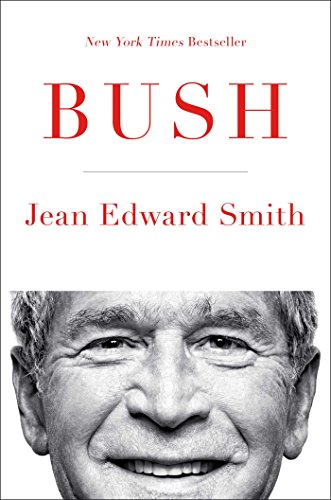
Bush / Jean Edward Smith.
Material type: TextLanguage: English Publisher: New York : Simon & Schuster, 2016Edition: First Simon & Schuster hardcover editionDescription: xxii, 808 pages : illustrations ; 24 cmContent type:
 - text
- unmediated
- volume
- 9781476741192
- 1476741190
- 973.931092 23
- E902 .S59 2016
| Item type | Current library | Home library | Collection | Shelving location | Call number | Copy number | Status | Barcode | |
|---|---|---|---|---|---|---|---|---|---|
 Libro
Libro
|
Biblioteca Juan Bosch | Biblioteca Juan Bosch | Automatización y Procesos Técnicos | Automatización y Procesos Técnicos (1er. Piso) | E902 .S59 2016 (Browse shelf(Opens below)) | 1 | Available | 00000193750 |
Includes bibliographical references (pages [747]-758) and index.
The wilderness years -- Turnaround -- "Don't mess with Texas" -- Governor -- The 2000 election -- The rule of law -- Inauguration -- March of the Hegelians -- Asleep at the switch -- Toppling the Taliban -- L'état, c'est moi -- The torture trail -- Waging aggressive war: the prelude -- Invasion -- "Mission accomplished" -- Four more years -- Katrina -- Perils of a second term -- The mess in Mesopotamia -- Rummy walks the plank -- Bush takes command -- AIDS -- Quagmire of the vanities -- Financial Armageddon -- Finis.
In this comprehensive and critically balanced biography, Jean Edward Smith examines the life and presidency of George W. Bush, the 43rd president of the United States. Drawing on a wealth of sources and firsthand accounts, Smith explores Bush’s upbringing, political rise, and controversial presidency with nuance and depth.
The book covers:
Bush’s early life, shaped by a powerful political family and a personal struggle to find direction.
His transformation after overcoming alcoholism, embracing evangelical Christianity, and entering politics.
The 2000 presidential election, the contested Supreme Court decision, and his unexpected presidency.
A deep analysis of 9/11, the Iraq War, and Bush’s central role in the decision to invade.
Domestic policies, including education reform, tax cuts, and response to Hurricane Katrina.
The 2008 financial crisis and the conclusion of his presidency, which Smith portrays as a mix of decisive leadership and costly misjudgments.
Smith is neither overly critical nor apologetic, offering a clear-eyed account of Bush’s legacy. He argues that Bush’s strength lay in his ability to make bold decisions—but that he was also dangerously insulated from dissenting views, which led to some of the most consequential errors of his administration.
There are no comments on this title.