
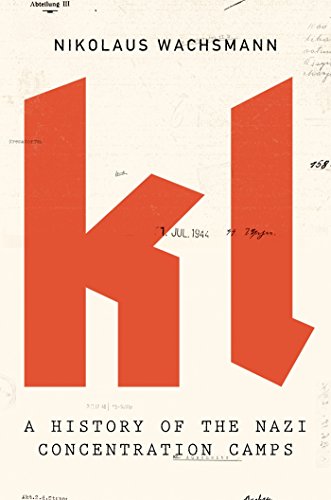
KL : a history of the Nazi concentration camps / Nikolaus Wachsmann.
Material type: TextLanguage: English Publication details: New York : Farrar, Straus and Giroux, 2016.Description: 865 pages, 32 unnumbered plates : illustrations, maps ; 21 cmISBN:
 - 9780374535926
- W114k 2016
| Item type | Current library | Home library | Collection | Shelving location | Call number | Copy number | Status | Barcode | |
|---|---|---|---|---|---|---|---|---|---|
 Libro
Libro
|
Biblioteca Juan Bosch | Biblioteca Juan Bosch | Automatización y Procesos Técnicos | Automatización y Procesos Técnicos (1er. Piso) | W114k 2016 (Browse shelf(Opens below)) | 1 | Available | 00000198099 |
Contenidos : Prologue
1. Early Camps
A Bloody Spring and Summer
Coordination
Open Terror
2. The SS Camp System
A Permanent Exception
The Camp SS
Prisoner Worlds
3. Expansion
Social Outsiders
Forced Labor
Jews
4. War
The Camp SS at War
Road to Perdition
Scales of Suffering
5. Mass Extermination
Killing the Weak
Executing Soviet POWs
Murderous Utopias
6. Holocaust
Auschwitz and the Nazi Final Solution
Factories of Death
Genocide and the KL System
7. Anus Mundi
Jewish Prisoners in the East
SS Routines
Plunder and Corruption
8. Economics and Extermination
Oswald Pohl and the WVHA
Slave Labor
“Guinea Pigs”
9. Camps Unbound
In Extremis
Satellite Camps
The Outside World
10. Impossible Choices
Coerced Communities
Kapos
Defiance
11. Death or Freedom
The Beginning of the End
Apocalypse
The Final Weeks
Epilogue
Wachsmann offers an unprecedented, integrated account of the Nazi concentration camps from their inception in 1933 through their demise, seventy years ago, in the spring of 1945. The Third Reich has been studied in more depth than virtually any other period in history, and yet until now there has been no history of the camp system that tells the full story of its broad development and the everyday experiences of its inhabitants, both perpetrators and victims, and all those living in what Primo Levi called 'the gray zone.' In KL, Wachsmann fills this glaring gap in our understanding. He not only synthesizes a new generation of scholarly work, much of it untranslated and unknown outside of Germany, but also presents startling revelations, based on many years of archival research, about the functioning and scope of the camp system. Examining, close up, life and death inside the camps, and adopting a wider lens to show how the camp system was shaped by changing political, legal, social, economic, and military forces, Wachsmann produces a unified picture of the Nazi regime and its camps.
There are no comments on this title.