
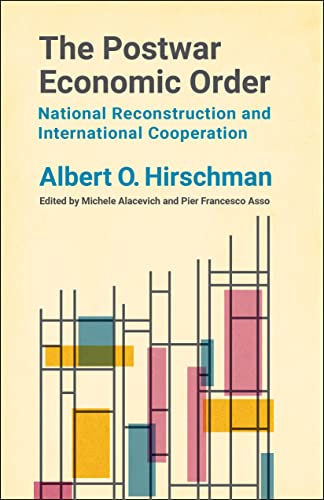
The postwar economic order : national reconstruction and international cooperation / Albert O. Hirschman ; edited by Michele Alacevich and Pier Francesco Asso.
Material type: TextLanguage: English Publisher: New York : Columbia University Press, [2023]Description: viii, 342 pages : illustrations ; 22 cmContent type:
 - text
- unmediated
- volume
- 9780231200585
- 9780231200592
- 337.7304 23/eng/20220627
- HF1456.5.E8 H669p 2023
| Item type | Current library | Home library | Collection | Shelving location | Call number | Copy number | Status | Barcode | |
|---|---|---|---|---|---|---|---|---|---|
 Libro
Libro
|
Biblioteca Juan Bosch | Biblioteca Juan Bosch | Automatización y Procesos Técnicos | Automatización y Procesos Técnicos (1er. Piso) | HF1456.5.E8 H669p 2023 (Browse shelf(Opens below)) | 1 | Available | 00000198159 |
Includes bibliographical references and index.
Contenidos :
Editors' Acknowledgments and a Note on the Texts Introduction: Albert O. Hirschman at the Federal Reserve, 1946-1952, by Michele Alacevich and Pier Francesco Asso
Part I. Patterns of European Reconstruction: Macroeconomic Challenges
1. Higher Interest Rates and the Credit Shortage in France
2. Exchange Control in Italy-I
3. Exchange Control in Italy-II
4. France and Italy: Patterns of Reconstruction
5. Public Finance, Money Markets, and Inflation in France
6. Credit Restrictions and Deflation in Italy Part II. The Marshall Plan and the End of Discrimination
7. Trade Structure of the "Marshall Plan Countries"
8. Inflation and Balance-of-Payments Deficit
9. Dollar Shortage and Discrimination
10. The OEEC Interim Report on the European Recovery Program-A Summary
11. The U.S. Recession and the Dollar Position of the OEEC Countries
12. The New Intra-European Payments Scheme
Part III. European Integration and the Way Back to Multilateralism
13. Proposal for a European Monetary Authority
14. Liberalization of the ECA Dollar: Introductory Note 15. European Payments Union-A Possible Basis for Agreement
16. Multilateralism and European Integration
17. The European Payments Union
18. Size and Distribution of the Public Debt in Selected Countries
19. The Long-Run Effect of Development and Industrialization Abroad on the United States
Part IV. The Economic Consequences of U.S. Hegemony
20. The Long-Run Effect of Development and Industrialization Abroad on the United States
21. The Influence of U.S. Economic Conditions on Foreign Countries (with Robert Solomon)
Index
"Between 1946 and 1952, Albert O. Hirschman, a German-born economist and wartime refugee, worked as an economic analyst in the Research Division of the Federal Reserve Board of the United States. He was first in charge of the Western European desk; later he was the Fed's representative to the Economic Cooperation Administration, the organization responsible for the Marshall Plan. In that capacity, Hirschman wrote a number of internal reports about early reconstruction policies in Europe, the first efforts at intra-European cooperation, and the uncertainties that surrounded the shaping of a new international economic order with the United States at its core. Europe, the Marshall Plan, and the Post-War International Order is a collection of these interrelated pieces compiled into book form. In aggregate they provide the reader with a behind the scenes view of the American rationale for an economically rebuilt and integrated Europe, written by someone who would go on to become one the the twentieth century's most significant economic thinkers. This collection offers a first-hand analysis of crucial developments in post-war European history and US-European relations. The essays featured here offer a nuanced and sophisticated analysis of major post-war problems such as the global "dollar shortage." Hirschman's skill and style are brought to the uncertainties of economic policymaking in the post-war years in a compelling manner, highlighting the often counterintuitive and paradoxical sequences of specific economic and political processes. Further, Hirschman's writings provide an advanced view of what would become signature concepts in his later work, including "inverted sequences," inducement mechanisms," and "staged sequences of policymaking." Europe, the Marshall Plan, and the Post-War International Order is a valuable addition to our understanding of the post-war international economic order and to Hirschman's critical thinking on processes of economic development, policymaking, and reform"-- Provided by publisher.
There are no comments on this title.