
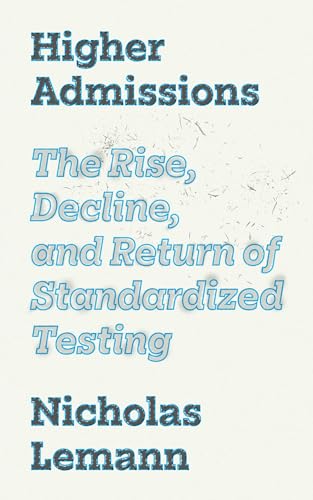
Higher admissions : the rise, decline, and return of standardized testing / Nicholas Lemann.
Material type: TextLanguage: English Series: Our compelling interests (Series)Publisher: Princeton: Princeton University Press, 2024Description: vi, 160 pages ; 21 cmContent type:
 - text
- unmediated
- volume
- 0691246769 (hardcover)
- 9780691246765 (hardcover)
- Universities and colleges -- United States -- Admission
- Universities and colleges -- United States -- Entrance examinations
- College entrance achievement tests -- United States
- Universidades y colegios -- Estados Unidos -- Admisión
- Universidades -- Estados Unidos -- Requisitos de ingreso
- Exámenes de admisión a la universidad -- Estados Unidos
- Universités -- États-Unis -- Admission
- Universités -- États-Unis -- Examens d'entrée
- Universités -- Admission -- Tests de rendement -- États-Unis
- 378.1/610973
- LB 2351.2 L547h 2024
| Item type | Current library | Home library | Collection | Shelving location | Call number | Copy number | Status | Barcode | |
|---|---|---|---|---|---|---|---|---|---|
 Libro
Libro
|
Biblioteca Juan Bosch | Biblioteca Juan Bosch | Humanidades | Humanidades (4to. Piso) | LB 2351.2 L547h 2024 (Browse shelf(Opens below)) | 1 | Available | 00000199016 |
Includes bibliographical references (pages 143-151) and index.
The birth of the American meritocracy -- Higher education for all -- Testing, Affirmative Action, and the law -- Admissions without testing -- Testing without meritocracy -- Commentary: Higher admissions, a California perspective / Patricia Gándara -- Commentary: The future of the meritocracy / Marvin Krislov -- Commentary: The multiple lives and ironies of the SAT / Prudence L. Carter.
How to make American higher education fairer--In the 1930s, American colleges and universities began to screen applications using the SAT, a mass-administered, IQ-descended standardized test. The widespread adoption of the test accompanied the development of the world's first mass higher education system--and served to promote the idea that the United States was becoming a "meritocracy" in which admission to selective higher education institutions would be granted to those who most deserved it. In Higher Admissions, Nicholas Lemann reflects on the state of America's aspirational meritocracy and the enduring value and meaning of standardized testing. Lemann writes that the anticipation of the Supreme Court's 2023 decision banning affirmative action, plus the Covid pandemic, led hundreds of universities to stop requiring standardized admissions tests; now many colleges and universities are reinstituting test requirements. The country is preoccupied with the admissions policies of the most selective universities, but Lemann redirects our attention to an alternate path that American higher education could have taken, and can still take--one that emphasizes selective admission less and significant upgrade of the entire higher education system more. Lemann argues that to improve the state of higher education overall, we should focus not on the narrow chokepoint of admission to highly selective colleges, but on efforts to create as much meaningful opportunity for flourishing in our vast higher education system for as many people as possible. The book includes thoughtful and challenging responses from Marvin Krislov, Patricia Gándara, and Prudence Carter.-- Front jacket flap.
There are no comments on this title.