
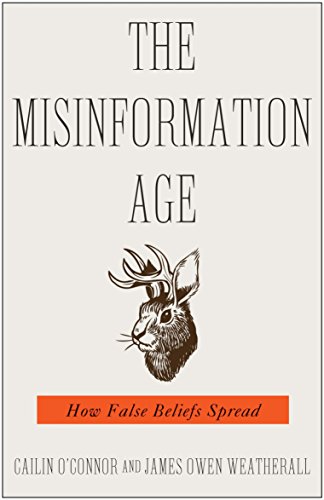
The misinformation age : how false beliefs spread / Cailin O'Connor and James Owen Weatherall.
Material type: TextLanguage: English Publisher: New Haven ; London : Yale University Press, [2019]Copyright date: ©2019Description: 1 online resource (ix, 266 pages) : illustrations ; 21 cmContent type:
 - text
- computer
- online resource
- 9780300251852
- How false beliefs spread
- 153.74 23
- BF323.E7 O'999m 2019
- LC 13000
| Item type | Current library | Home library | Collection | Shelving location | Call number | Copy number | Status | Barcode | |
|---|---|---|---|---|---|---|---|---|---|
 Libro
Libro
|
Biblioteca Juan Bosch | Biblioteca Juan Bosch | Automatización y Procesos Técnicos | Automatización y Procesos Técnicos (1er. Piso) | BF323.E7 O'999m 2019 (Browse shelf(Opens below)) | 1 | Available | 00000199042 |
Includes bibliographical references and index.
Introduction. The Vegetable Lamb of Tartary -- ONE. What Is Truth? -- TWO. Polarization and Conformity -- THREE. The Evangelization of Peoples -- FOUR. The Social Network.
The social dynamics of "alternative facts": why what you believe depends on who you know Why should we care about having true beliefs? And why do demonstrably false beliefs persist and spread despite consequences for the people who hold them? Philosophers of science Cailin O'Connor and James Weatherall argue that social factors, rather than individual psychology, are what's essential to understanding the spread and persistence of false belief. It might seem that there's an obvious reason that true beliefs matter: false beliefs will hurt you. But if that's right, then why is it (apparently) irrelevant to many people whether they believe true things or not? In an age riven by "fake news," "alternative facts," and disputes over the validity of everything from climate change to the size of inauguration crowds, the authors argue that social factors, not individual psychology, are what's essential to understanding the persistence of false belief and that we must know how those social forces work in order to fight misinformation effectively.
In English.
Description based on print version record.
There are no comments on this title.