
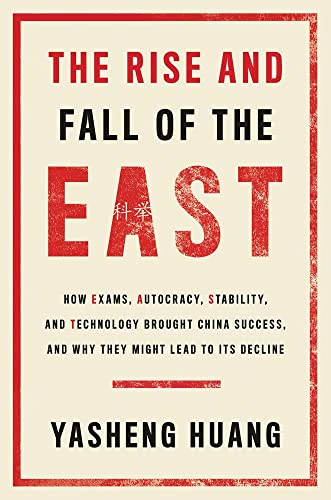
The rise and fall of the East : how exams, autocracy, stability, and technology brought China success, and why they might lead to its decline / Yasheng Huang.
Material type: TextLanguage: English Publisher: New Haven : Yale University Press, 2023Description: xiii, 420 pages : illustrations, maps ; 25 cmContent type:
 - text
- unmediated
- volume
- 9780300266368 (hbk.)
- 0300266367 (hbk.)
- 330.951
- HC 427.95 H874r 2023
| Item type | Current library | Home library | Collection | Shelving location | Call number | Copy number | Status | Barcode | |
|---|---|---|---|---|---|---|---|---|---|
 Libro
Libro
|
Biblioteca Juan Bosch | Biblioteca Juan Bosch | Ciencias Sociales | Ciencias Sociales (3er. Piso) | HC 427.95 H874r 2023 (Browse shelf(Opens below)) | 1 | Available | 00000192975 |
Includes bibliographical references (pages 383-408) and index.
PART I EXAMINATION
Keju as a Scaling Instrument
Organizing China-and the CCP
PART II AUTOCRACY
A State without a Society
Reversion to the Autocratic Mean
PART III STABILITY
What Makes Chinese Autocracy So Stable?
Tullock's Curse
PART IV TECHNOLOGY
Reframing the Needham Question
A Republic of Government
PART V THE FUTURE OF THE EAST MODEL
The CCP of Xi Jinping
Breaking Out of the EAST Model?
"Chinese society has been shaped by the interplay of the EAST--exams, autocracy, stability, and technology--from ancient times through the present. Beginning with the Sui dynasty's introduction of the civil service exam, known as Keju, in 587 CE--and continuing through the personnel management system used by the Chinese Communist Party (CCP)--Chinese autocracies have developed exceptional tools for homogenizing ideas, norms, and practices. But this uniformity came with a huge downside: stifled creativity. Yasheng Huang shows how China transitioned from dynamism to extreme stagnation after the Keju was instituted. China's most prosperous periods, such as during the Tang dynasty (618-907) and under the reformist CCP, occurred when its emphasis on scale (the size of bureaucracy) was balanced with scope (diversity of ideas). Considering China's remarkable success over the past half-century, Huang sees signs of danger in the political and economic reversals under Xi Jinping. The CCP has again vaulted conformity above new ideas, reverting to the Keju model that eventually led to technological decline. It is a lesson from China's own history, Huang argues, that Chinese leaders would be wise to take seriously."--Dust jacket.
There are no comments on this title.