
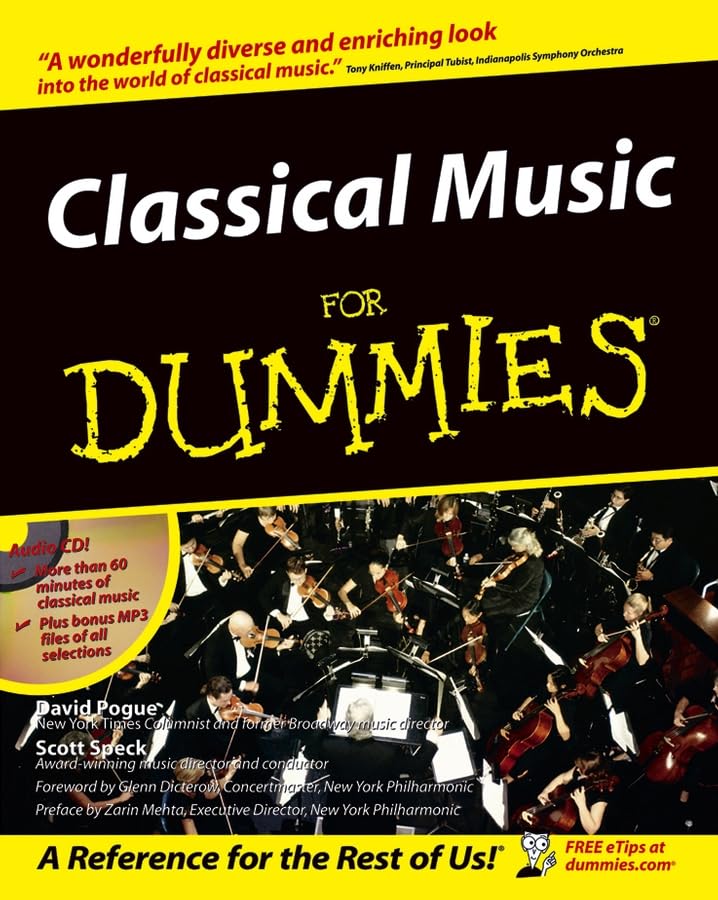
Classical music for dummies / by David Pogue and Scott Speck ; preface by Zarin Mehta ; foreword by Glenn Dicterow.
Material type: TextLanguage: English Series: --For dummies | --for dummiesPublication details: Hoboken, New Jersey : John Wiley & Sons, Inc., c1997.Description: xxvi, 356 p. : ill. ; 24 cm. + 1 CD-ROM ; (4 3/4 in.)ISBN:
 - 9780764550096
- 781.6/8 21
- MT 6 P746c 1997
| Item type | Current library | Home library | Collection | Shelving location | Call number | Copy number | Status | Barcode | |
|---|---|---|---|---|---|---|---|---|---|
 Libro
Libro
|
Biblioteca Juan Bosch | Biblioteca Juan Bosch | Humanidades | Humanidades (4to. Piso) | MT 6 P746c 1997 (Browse shelf(Opens below)) | 1 | Available | 00000121642 |
Copyright from CD-ROM.
CD-ROM contains CD audio tracks and MP3 files.
Includes index.
Prying open the classical music oyster --
The entire history of music in 80 pages --
How to spot a sonata --
Dave 'n' Scott's e-z concert survival guide --
A spin through your free CD --
Intermission : backstage tour --
Keyboards & Co. --
Strings attached --
Gone with the woodwinds --
The top (and bottom) brass --
Percussion's greatest hits --
The dreaded music theory chapter --
Once more, with feeling : tempo, dynamics, and orchestration --
The ten most common misconceptions about classical music --
The ten best musical terms for cocktail parties --
Ten great chamber music pieces --
Ten great classical music jokes --
Ten ways to go beyond this book --
Appendixes. Starting a classical music collection ; Classical music timeline ; Glossary. CD-ROM contents: Water music suite no. 2. Alla hornpipe / Handel --
Well tempered clavier, book 2. Prelude and fugue in C major / Bach --
Piano concerto no. 22 in E-flat. Third movement / Mozart --
Symphony no. 5. First movement / Beethoven --
Symphony no. 4. Third movement / Brahms --
Serenade for strings. Fourth movement / Dvořák --
Symphony no. 6. Fourth movement / Tchaikovsky --
La mer. Dialogue du vent et de la mer / Debussy --
The rite of spring. Opening to the end of Jeu de rapt / Stravinsky.
This guide provides an insight into what makes classical music sound the way it does, by discussing musical eras, scores, instruments and other important background information. It contains tips on how to discover music readers will enjoy most and advice on building a classical music library.
System requirements for accompanying computer laser optical disc: Macintosh or Windows; CD-ROM drive. Musical selections also playable on an audio CD player.
There are no comments on this title.