
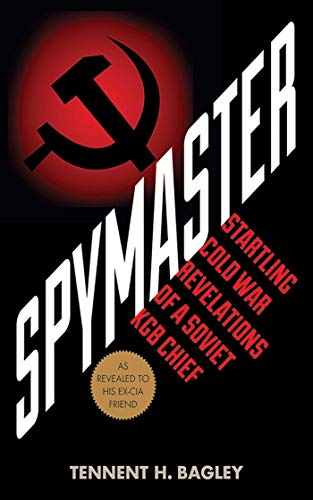
Spymaster : startling cold war revelations of a Soviet KGB Chief/ Tennent H. Bagley
Material type: TextLanguage: English Publication details: New York, NY : Skyhorse Publishing, 2013Description: xvii, 302 p. : ill. ; 23 cmISBN:
 - 9781626360655
- 1626360650
- 327.12470092
- JN 6529 B146s 2013
| Item type | Current library | Home library | Collection | Shelving location | Call number | Vol info | Copy number | Status | Barcode | |
|---|---|---|---|---|---|---|---|---|---|---|
 Libro
Libro
|
Biblioteca Juan Bosch | Biblioteca Juan Bosch | Ciencias Sociales | Ciencias Sociales (3er. Piso) | JN 6529 B146s 2013 (Browse shelf(Opens below)) | 1 | 1 | Available | 00000105688 |
Includes index.
Breaking American ciphers—and starting a war -- Two views of culture -- Target: the American Embassy -- Inside a deadly purge -- Into foreign intelligence—and England -- A mole and a tunnel -- "Why do you need all those people here?" -- A unique look at the Hungarian revolution -- Spy center Vienna -- The KGB's Nazi underground -- Richard Sorge redux -- Organizing to disinform -- Active measures -- "How could CIA ever have believed in that man?" -- The top hat paradox -- Prague Spring at the Politburo -- Other places -- The irony of Helsinki -- Watching it end -- Epilogue.
From the dark days of World War II through the Cold War, Sergey A. Kondrashev was a major player in Russia's notorious KGB espionage apparatus. Rising through its ranks through hard work and keen understanding of how the spy and political games are played, he "handled" American and British defectors, recruited Western operatives as double agents, served as a ranking officer at the East Berlin and Vienna KGB bureaus, and tackled special assignments from the Kremlin.During a 1994 television program about former spymasters, Kondrashev met and began a close friendship with a former foe, ex-CIA officer Tennent H. "Pete" Bagley, whom the Russian asked to help write his memoirs.Because Bagley knew so about much of Kondrashev's career (they had been on opposite sides in several operations), his penetrating questions and insights reveal slices of never-revealed espionage history that rival anything found in the pages of Ian Fleming, Len Deighton, or John le Carre chilling tales of surviving Stalin's purges while superiors and colleagues did not, of plotting to reveal the Berlin Tunnel, of quelling the Hungarian Revolution and "Prague Spring" independence movements, and of assisting in arranging the final disposition of the corpses of Adolf Hitler and Eva Braun. Kondrashev also details equally fascinating KGB propaganda and disinformation efforts that shaped Western attitudes throughout the Cold War.Because publication of these memoirs was banned by Putin's regime, Bagley promised Kondrashev to have them published in the West. They are now available to all who are fascinated by vivid tales of international intrigue. This voyage back into the darker regions or the Cold War began in a little country inn in eastern Germany. As I walked into the sunny breakfast room, the sparkle of silver-ware on an undisturbed sea of white tablecloths showed me I was early. But not the earliest: a thin and bespectacled man sat alone at a corner table. I recognized him as another participant in the TV production that had brought me there, so I walked up to him. "May I join you?" I asked. "Please do," he replied with a welcoming gesture toward the seat to his right. We introduced ourselves, but he evidently knew me already, just as I knew him. In fact, this man and I had probably known of each other for more than thirty years. He was Sergey Kondrashev, one of the KGB's most influential figures during the Cold War years, when on the other side I had been supervising CIA's work against his service. Having long grappled with Soviet deception operations, I was about to breakfast with a man who had run them.
There are no comments on this title.