
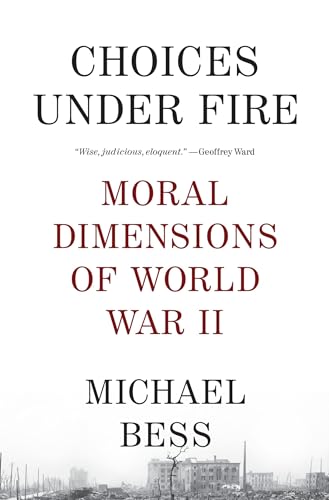
Choices under fire : moral dimensions of World War II / Michael Bess.
Material type: TextPublication details: New York : Vintage Books, 2008, c2006.Edition: 1st Vintage Books edDescription: xiii, 395 p. : ill. ; 21 cmISBN:
 - 9780307275806 (pbk.)
- 0307275809 (pbk.)
- D744.4 B557c 2006
| Item type | Current library | Home library | Collection | Shelving location | Call number | Vol info | Copy number | Status | Barcode | |
|---|---|---|---|---|---|---|---|---|---|---|
 Libro
Libro
|
Biblioteca Juan Bosch | Biblioteca Juan Bosch | Recursos Regionales | Recursos Regionales (2do. Piso) | D744.4 B557c 2006 (Browse shelf(Opens below)) | 3 | 1 | Available | 00000091788 |
Originally published: New York : Knopf, 2006.
Includes bibliographical references (p. [371]-380) and index.
Introduction : evaluating the Second World War : celebration, doubt, and complexity -- A wide world of racisms -- Causes of the Pacific War : a longer view on Pearl Harbor -- Causes of the war in Europe : the paradoxical legacy of Munich -- Bystanders : how much is not enough? -- Bombing civilian populations : a case of moral slippage -- Deep evil and deep good : the concept of human nature confronts the Holocaust -- Decisions at Midway, 1942 : moral character as a factor in battle -- Tyranny triumphant : the moral awkwardness of the alliance with Stalin -- Kamikaze : wartime suicide attacks in anthropological perspective -- The decision to drop the atomic bomb : twelve questions -- Justice for the unspeakable? : the enduring legacy of the war crimes trials at Nuremberg and Tokyo -- Generations under a shadow : the challenge of peace since Hiroshima -- The politics of memory : remembering and unremembering wartime -- Conclusion : what would be the opposite of Hitler's world?
World War II remains in our collective memory the "good war" in which the forces of freedom triumphed over the forces of darkness. Now, historian Bess explodes the myth that this was a war without moral ambiguity. Although undeniably a just war--of defense against unprovoked aggression--it was fraught with painful dilemmas, uneasy trade-offs, and unavoidable compromises. Bess confronts its most difficult questions: Was the bombing of civilian populations in Germany and Japan justified? Were the war crimes trials legally scrupulous? What is the legacy of Hiroshima? And what are the long-term ramifications of the Anglo-American alliance with Stalin, whose atrocities rivaled those of Hitler? Bess examines the factors that led some people to dissent and defy evil while others remained aloof, caught in operations they saw as beyond their control, and shows how long-simmering controversies still have the power to divide nations more than half a century later.--From publisher description.
There are no comments on this title.