
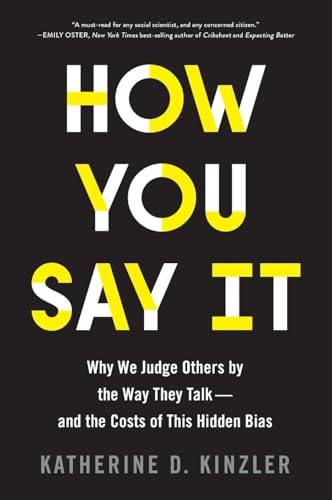
How you say it : why we judge others by the way they talk--and the costs of this hidden bias / Katherine D. Kinzler
Language: eng Publication details: Boston : Houghton Mifflin Harcourt, 2020Description: xvi, 231 p. ; 22 cmISBN:- 9780358567103
- 0358567106
- 302.2
- P 40.5 K56h 2020
| Item type | Current library | Home library | Collection | Shelving location | Call number | Copy number | Status | Barcode | |
|---|---|---|---|---|---|---|---|---|---|
 Libro
Libro
|
Biblioteca Juan Bosch | Biblioteca Juan Bosch | Humanidades | Humanidades (4to. Piso) | P 40.5 K56h 2020 (Browse shelf(Opens below)) | 1 | Available | 00000155760 |
"Mariner Books."
Introduction: it's not what you say --
How you speak is who you are --
Native tongues --
How language divides us --
Deep talk --
Little bigots? --
On the basis of speech --
A linguistics revolution --
Afterword: it's not what you say.
"We gravitate toward people like us; it's human nature. Race, class, and gender affect this social identity, but one overlooked factor can be even more powerful: the way we speak. As pioneering psychologist Katherine Kinzler reveals in How You Say It, that's because our speech largely reflects the voices we heard as children. We can change how we speak to some extent, whether by "code-switching" between dialects or learning a new language. But for the most part we are forever marked by our native tongue-and are hardwired to prejudge others by theirs, often with serious consequences. Your accent alone can determine the economic opportunity or discrimination you encounter in life, making speech one of the most urgent social-justice issues of our day. Ultimately, Kinzler shows, our linguistic differences can also be a force for good. For her research reveals that exposure to different languages is beneficial--a paradox that hints at the benefits we can reap from mastering this ancient source of tribalism"
There are no comments on this title.