
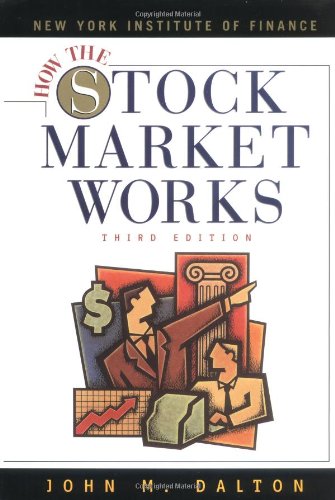
How the stock market works / John M. Dalton.
Material type: TextLanguage: English Series: How the markets work seriesPublication details: New York : New York Institute of Finance, c2001.Edition: 3rd editionDescription: xvi, 422 pages : illustrations ; 24 cmISBN:
 - 0735201838
- 9780735201835
- 332.64/273
- HG 4551 D152h 2001
| Item type | Current library | Home library | Collection | Shelving location | Call number | Copy number | Status | Barcode | |
|---|---|---|---|---|---|---|---|---|---|
 Libro
Libro
|
Biblioteca Juan Bosch | Biblioteca Juan Bosch | Ciencias Sociales | Ciencias Sociales (3er. Piso) | HG 4551 D152h 2001 (Browse shelf(Opens below)) | 1 | Available | 00000190450 |
Revised edition of: How the stock market works / edited by John M. Dalton. 2nd ed. 1993
Includes index.
• The stock market : what the stock market has to offer
• Reading the financial press : determining share value
•determining your investment return
• The initial public offering : getting the stocks to the marketplace
• Inside the brokerage firm : who does what?
• The secondary market : executing orders on the exchange floor
• The specialist : riding the bulls and bears
• The secondary market : over-the counter-trading
• Investment companies : closed-end and open-end funds
•the "package-plan" approach
• Stock options : multipurpose instruments
• The back offices : following the long paper trail
• Stock market theories : can prices really be predicted?
• Analyzing stocks : the corporation's "report card"
• Taxation : how dividends and capital gains are taxed
• Crash! : how the stock market works under pressure.
The second edition of the popular How The Stock Market Works updates and expands its solid introduction to Wall Street for individual investors and beginning financial professionals alike. This primer explains the workings of the securities industry as a whole, including the initial public offering (getting the stocks to the marketplace), types of stocks, who's who inside the brokerage firm, executing orders on the Exchange floor, the role of the specialist, the over-the-counter market, back office operations (buy/sell and processing procedures), and the major theories of market analysis. The second edition has six new chapters, covering why individuals and institutions buy stocks: dividends and capital gains, risks and rewards; how to read the financial press ... stock symbols, dividend, yield, P/E ratio; closed-end and open-end funds ... how mutual funds are priced, bought and sold ... figuration of net asset values and offering prices; stock options ... puts and calls ... leverage ... time value and intrinsic value ... options as hedging tools; how to understand a corporate balance sheet and income statement; and how dividends and capital gains are taxed.
There are no comments on this title.