
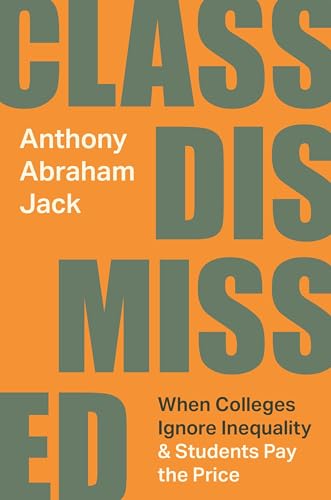
Class dismissed : when colleges ignore inequality and students pay the price / Anthony Abraham Jack.
Material type: TextLanguage: English Publisher: Princeton ; Oxford : Princeton University Press, 2024Description: x, 293 pages ; 25 cmContent type:
 - text
- unmediated
- volume
- 9780691237466 (hardback)
- 0691237468 (hardback)
- Minorities -- Education (Higher) -- United States
- Minority college students -- United States -- Social conditions
- Universities and colleges -- United States -- Evaluation
- Educational equalization -- United States
- Minorías -- Educación superior -- Estados Unidos
- Universidades y colegios -- Estados Unidos -- Evaluación
- Igualdad educativa -- Estados Unidos
- 378.1/980973
- LC 3727 J12c 2024
| Item type | Current library | Home library | Collection | Shelving location | Call number | Copy number | Status | Barcode | |
|---|---|---|---|---|---|---|---|---|---|
 Libro
Libro
|
Biblioteca Juan Bosch | Biblioteca Juan Bosch | Humanidades | Humanidades (4to. Piso) | LC 3727 J12c 2024 (Browse shelf(Opens below)) | 1 | Available | 00000196750 |
Browsing Biblioteca Juan Bosch shelves, Shelving location: Humanidades (4to. Piso), Collection: Humanidades Close shelf browser (Hides shelf browser)

|

|

|

|

|

|

|
||
| LC3715 .G162e 2004 Education in divided societies / | LC 3715 G216b 2009 Bilingual education in the 21st century : a global perspective / | LC 3727 A178 2001 Achieving against the odds : how academics become teachers of diverse students / | LC 3727 J12c 2024 Class dismissed : when colleges ignore inequality and students pay the price / | LC 3731 B859b 1998 Bilingual education : from compensatory to quality schooling / | LC 3731 C971n 1996 Negotiating identities : education for empowerment in a diverse society / | LC 3731 P887 2002 The power of culture : teaching across language difference / |
Includes bibliographical references and index.
Part 1. Family -- Part 2. Finances -- Part 3. Fault Lines.
"A book that examines how structural inequalities directly influence undergraduate life. Universities love to talk about diversity. They spend millions of dollars advertising just how diverse they, offering diversity statistics that are personalized with pictures. But Anthony Jack argues that this is a superficial approach. He calls it a "gift shop" approach that displays groups like trinkets and fails to truly serve students from underrepresented groups. Moreover, social class is almost entirely absent from the conversation. Never before have the platitudes of diversity left universities ill-prepared to support their students--especially those who are lower-income and/or first generation--than during the COVID-19 pandemic. Blinded by Diversity sheds lights on how entrenched inequalities in students homes and communities shape undergraduate life through the lens of how students coped with COVID-19, navigated social unrest, and experienced problems of race. Jack draws on 160 in-depth interviews with a representative sample of Asian, Black, Latino, Native and White undergraduate at Harvard and 20 interviews with students from other universities. He first examines students home lives prior to college and campus closures and explores how the pandemic shaped their lives away from campus. He looks at those who have jobs and explores how the divergent work experiences that students have shape their broader college experience. He looks at students' strategies for navigating campus, including peer group formation and acclimation to college. The final empirical chapter explores how students understand and navigate racial unrest both on campus and in America and how their experiences vary by race. The conclusion will outline sensible and practical solutions to aid colleges in their quest to help all students"-- Provided by publisher.
There are no comments on this title.