
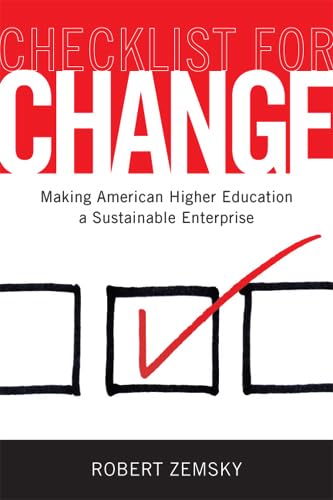
Checklist for change : making American higher education a sustainable enterprise / Robert Zemsky.
Material type: TextLanguage: English Publisher: New Brunswick, New Jersey : Rutgers University Press, 2013Description: x, 243 pages ; 24 cmContent type:
 - text
- unmediated
- volume
- 9780813561349 (hardcover : alk. paper)
- 0813561345 (hardcover : alk. paper)
- 378.73
- LA 227.4 Z53c 2013
| Item type | Current library | Home library | Collection | Shelving location | Call number | Copy number | Status | Barcode | |
|---|---|---|---|---|---|---|---|---|---|
 Libro
Libro
|
Biblioteca Juan Bosch | Biblioteca Juan Bosch | Humanidades | Humanidades (4to. Piso) | LA 227.4 Z53c 2013 (Browse shelf(Opens below)) | 1 | Available | 00000191697 |
Browsing Biblioteca Juan Bosch shelves, Shelving location: Humanidades (4to. Piso), Collection: Humanidades Close shelf browser (Hides shelf browser)
| No cover image available |

|

|

|

|

|

|
||
| LA 227.4 T566w 2003 Who's in charge of America's research universities : a blueprint for reform / | LA 227.4 W555 2012 What is college for? : the public purpose of higher education / | LA227.4 W631 1999 Universities, think tanks, and war colleges : a memoir / | LA 227.4 Z53c 2013 Checklist for change : making American higher education a sustainable enterprise / | LA 227.4 Z53r 2005 Remaking the American university : market-smart and mission-centered / | LA 227.4 Z72c 2016 Campus politics : what everyone needs to know® / | LA 228 E24h 2018 The heart of the humanities : reading, writing, teaching / |
Includes bibliographical references and index.
Trapped in an Ecclesiastes moment -- A faculty encamped just north of Armageddon -- A federalized market with little incentive to change -- A regulatory quagmire -- A troublesome fractiousness -- A disruptive lexicon -- A different footprint -- A liberal arts conundrum -- A new peace treaty -- A stronger faculty voice -- A competent curriculum -- A federal commitment to fix, fund, and facilitate.
Almost every day American higher education is making news with a list of problems that includes the incoherent nature of the curriculum, the resistance of the faculty to change, and the influential role of the federal government both through major investments in student aid and intrusive policies. Checklist for Change not only diagnoses these problems, but also provides constructive recommendations for practical change. Robert Zemsky details the complications that have impeded every credible reform intended to change American higher education. He demythologizes such initiatives as the Morrill Act, the GI Bill, and the Higher Education Act of 1972, shedding new light on their origins and the ways they have shaped higher education in unanticipated and not commonly understood ways. Next, he addresses overly simplistic arguments about the causes of the problems we face and builds a convincing argument that well-intentioned actions have combined to create the current mess for which everyone is to blame. Using provocative case studies, Zemsky describes the reforms being implemented at a few institutions with the hope that these might serve as harbingers of the kinds of change needed: the University of Minnesota at Rochester's compact curriculum in the health sciences only, Whittier College's emphasis on learning outcomes, and the University of Wisconsin Oshkosh's coherent overall curriculum
There are no comments on this title.