
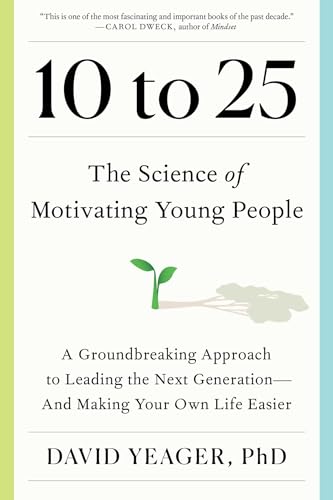
10 to 25 : the science of motivating young people : a groundbreaking approach to leading the next generation-and making your own life easier / David Yeager, PhD.
Material type: TextLanguage: English Publisher: New York : Avid Reader Press, an imprint of Simon & Schuster, LLC, 2024Edition: First Avid Reader Press hardcover editionDescription: 454 pages : illustrations ; 24 cmContent type:
 - text
- unmediated
- volume
- 9781668023884 (hardcover)
- 1668023881 (hardcover)
- Ten to twenty-five
- 153.8
- BF 724.3 Y37t 2024
| Item type | Current library | Home library | Collection | Shelving location | Call number | Copy number | Status | Barcode | |
|---|---|---|---|---|---|---|---|---|---|
 Libro
Libro
|
Biblioteca Juan Bosch | Biblioteca Juan Bosch | Humanidades | Humanidades (4to. Piso) | BF 724.3 Y37t 2024 (Browse shelf(Opens below)) | 1 | Available | 00000198058 |
Browsing Biblioteca Juan Bosch shelves, Shelving location: Humanidades (4to. Piso), Collection: Humanidades Close shelf browser (Hides shelf browser)

|

|

|

|

|

|

|
||
| BF 723 W136e 2017 Les enfants intellectuellement précoces / | BF 724 S819a 1999 Adolescence / | BF 724.3 C958t 1993 Talented teenagers : the roots of success and failure / | BF 724.3 Y37t 2024 10 to 25 : the science of motivating young people : a groundbreaking approach to leading the next generation-and making your own life easier / | BF 724.5 J42d 2012 The defining decade : why your twenties matter and how to make the most of them now / | BF 724.5 J42d 2013 The defining decade : why your twenties matter and how to make the most of them now / | BF 724.5 J42d 2021 The defining decade : why your twenties matter and how to make the most of them now / |
Includes bibliographical references and index.
Introduction
Section I. Understanding ten-to-twenty-five-year-olds. What we get wrong
The mentor mindset
The generational divide
Acquiring the mentor mindset
Section II. Mentor-mindset practices. Transparency
Questioning
Stress
Purpose
Belonging
Section III. Building a better future. Inclusive excellence
Future growth, part one
Future growth, part two
Coda
Putting it into practice
Acknowledgments
Notes
Index
"Acclaimed developmental psychologist David Yeager reveals the new science of motivating young people ages ten through twenty-five"-- Provided by publisher.
"Acclaimed developmental psychologist David Yeager-who has worked alongside Angela Duckworth (Grit), Carol Dweck (Mindset), and Paul Tough (How Children Succeed)-reveals the new science of motivating young people ages ten through twenty-five in an illuminating and practical book that is a must-read for managers, parents, educators, coaches, and mentors everywhere. Imagine a world in which Gen Xers, millennials, and boomers interact with young people in ways that leave them feeling inspired, enthusiastic, and ready to contribute-rather than disengaged, outraged, or overwhelmed. That world may be closer than you think. In this book based on cutting edge research, psychologist David Yeager explains how to stop fearing young people's brains and hormones and start harnessing them. Neuroscientists have discovered that around age ten, puberty spurs the brain to crave socially rewarding experiences, such as pride, admiration, and respect, and to become highly averse to social pain, such as humiliation or shame. As a result, young people are subtly reading between the lines of everything we say, trying to interpret the hidden implications of our words to find out if we are disrespecting or honoring them. Surprisingly, this sensitivity to status and respect continues into the mid-twenties. 10 to 25 helps adults develop an ear for the difference between the right and wrong way to respect young people and avoid frustrating patterns of miscommunication and conflict. Yeager explains how to adopt what he terms the mentor mindset, which is a leadership style that's attuned to young people's need for status and respect. Anyone can adopt the mentor mindset by following a few highly effective and easy-to-learn practices such as validating young people's perspectives (rather than dismissing them), asking them questions (rather than telling them what to do), being transparent about your beliefs and goals (rather than assuming that they will accurately guess your thoughts), and holding them to high standards (rather than coddling them). Yeager's scientific experiments have shown these practices reduce a wide variety of behavior problems, including school dropout, unhealthy eating, stress, purposelessness, mental health problems, and more. One of the biggest misconceptions about mentoring is that it takes up too much time. On the contrary, those who use the mentor mindset end up with more time. Through back-and-forth conversations, young people feel empowered, and managers can transfer responsibility to them. Young people in this age group are poised to learn, grow, and accomplish incredible things-if only we can tap into the basic neurobiological systems that drive their motivation and behavior. An essential read for anyone who interacts with young people, 10 to 25 is a groundbreaking book that offers long-term strategies to help nurture well-adjusted, independent, accomplished young people who contribute to society in positive ways-all while making our own lives easier"-- Provided by publisher.
There are no comments on this title.