
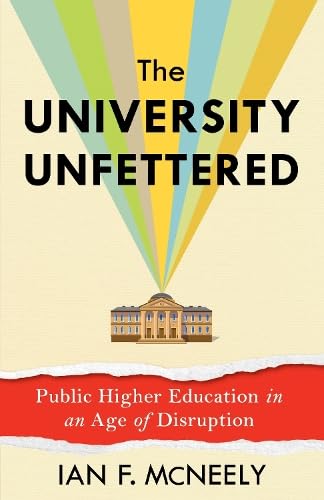
The University Unfettered : Public Higher Education in an Age of Disruption / Ian F. McNeely.
Material type: TextLanguage: English Publisher: New York : Columbia University Press, [2025]Description: 334 pages ; 23 cmContent type:
 - text
- unmediated
- volume
- 9780231218405
- 9780231220583
- 378.795/31 23/eng/20250117
- LD4350.7 M478u 2025
| Item type | Current library | Home library | Collection | Shelving location | Call number | Copy number | Status | Barcode | |
|---|---|---|---|---|---|---|---|---|---|
 Libro
Libro
|
Biblioteca Juan Bosch | Biblioteca Juan Bosch | Automatización y Procesos Técnicos | Automatización y Procesos Técnicos (1er. Piso) | LD4350.7 M478u 2025 (Browse shelf(Opens below)) | 1 | Available | 00000199024 |
Includes bibliographical references and index.
The public -- Students -- Faculty -- Administrators -- Research -- Teaching -- Diversity -- Impact.
"The public university as we once knew it is gone and never coming back. That was the stark conclusion reached by many higher education leaders in the Great Recession of 2008-09. It seems truer today than ever before. After generations of fickle state support, public universities behave more and more like their private counterparts - charging what the market will bear, offering what consumers demand, competing relentlessly with peers, and managing their own priorities, strategies, and resources. But looking back on how we got here offers surprising reassurance. America's public universities emerged largely intact after the 2010s, a decade of disruption bookended by a once-in-a-lifetime financial crisis and a once-in-a-century pandemic. Resisting widespread calls for corporate reinvention or "disruptive innovation," they hewed to their core missions. If anything, exposure to the rigors of competition and the discipline of the market only enhanced their longstanding commitments to the public good. In The University Unfettered Ian F. McNeely explains the paradox of the "post-public" university and asks what we must still do to improve upon it. He draws on his experiences at the University of Oregon, a public flagship that he argues was ahead of its peers in coping with state disinvestment and repositioning itself for an independent future. During the 2010s, it fought for and won the right to govern itself, triggered the dissolution of the state's entire university system, and reaped the then-largest private donation ever bestowed on a public institution. But the saga of its internal transformation is even more significant for what it reveals about American higher education at large. McNeely guides the reader through fundamental questions about how contemporary universities must juggles rival stakeholders and balance competing missions - questions about how money is spent, how education and knowledge are pursued, how decisions get made, and how internal and external constituencies influence them. Each chapter blends an informed reconstruction of real-world dilemmas with concise analyses of the entire public university sector, drawing on higher education policy, history, sociology, and economics. The resulting account explains the inner workings of public universities as experienced by those who manage them. Its unexpected conclusion is that the divergent and often disharmonious interests of politicians, students, faculty, and administrators nonetheless converge on sustaining public-minded commitments to research, teaching, diversity, and social impact"-- Provided by publisher.
There are no comments on this title.