
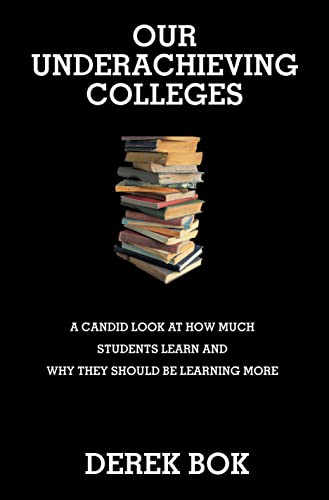
Our underachieving colleges : a candid look at how much students learn and why they should be learning more / Derek Bok.
Material type: TextLanguage: English Publication details: Princeton, N.J. ; Woodstock : Princeton University Press, 2006.Description: 429 pages ; 24 cmISBN:
 - 9780691136189 (pbk.)
- 0691136181 (pbk.)
- 9780691125961 (hardcover ; alk. paper)
- 0691125961 (hardcover ; alk. paper)
- 378.73
- LB 2322.2 B686o 2006
| Item type | Current library | Home library | Collection | Shelving location | Call number | Copy number | Status | Barcode | |
|---|---|---|---|---|---|---|---|---|---|
 Libro
Libro
|
Biblioteca Juan Bosch | Biblioteca Juan Bosch | Humanidades | Humanidades (4to. Piso) | LB 2322.2 B686o 2006 (Browse shelf(Opens below)) | 1 | Available | 00000078401 |
Browsing Biblioteca Juan Bosch shelves, Shelving location: Humanidades (4to. Piso), Collection: Humanidades Close shelf browser (Hides shelf browser)

|

|

|

|

|

|

|
||
| LB 2322.2 A432h 2003 Habits of mind : fostering access and excellence in higher education / | LB 2322.2 A465g 2016 Global perspectives on higher education / | LB 2322.2 A638r 2018 Robot-proof : higher education in the age of artificial intelligence / | LB 2322.2 B686o 2006 Our underachieving colleges : a candid look at how much students learn and why they should be learning more / | LB 2322.2 B932 2018 Building the intentional university : Minerva and the future of higher education / | LB 2322.2 C266a 1999 Aventuras y desventuras de la educación superior en Guadalajara durante el siglo XIX / | LB 2322.2 C711s 2017 Speaking of universities / |
Includes bibliographical references and index.
The evolution of American colleges
Faculty attitudes toward undergraduate education
Purposes
Learning to communicate
Learning to think
Building character
Preparation for citizenship
Living with diversity
Preparing for a global society
Acquiring broader interests
Preparing for a career
Improving the quality of undergraduate education
Drawing on a large body of empirical evidence, former Harvard President Derek Bok examines how much progress college students actually make toward widely accepted goals of undergraduate education. His conclusions are sobering. Although most students make gains in many important respects, they improve much less than they should in such important areas as writing, critical thinking, quantitative skills, and moral reasoning. Large majorities of college seniors do not feel that they have made substantial progress in speaking a foreign language, acquiring cultural and aesthetic interests, or learning what they need to know to become active and informed citizens. Overall, despite their vastly increased resources, more powerful technology, and hundreds of new courses, colleges cannot be confident that students are learning more than they did fifty years ago. Looking further, Bok finds that many important college courses are left to the least experienced teachers and that most professors continue to teach in ways that have proven to be less effective than other available methods. In reviewing their educational programs, however, faculties typically ignore this evidence. Instead, they spend most of their time discussing what courses to require, although the lasting impact of college will almost certainly depend much more on how the courses are taught. In his s final chapter, Bok describes the changes that faculties and academic leaders can make to help students accomplish more. Without ignoring the contributions that America's colleges have made, Bok delivers a powerful critique--one that educators will ignore at their peril.
There are no comments on this title.