
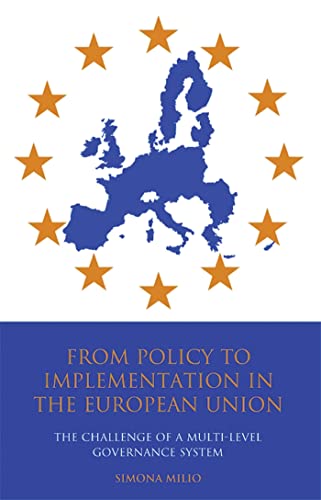
From policy to implementation in the European Union : the challenge of a multi-level governance system / Simona Milio.
Material type: TextLanguage: English Publication details: London ; New York : I.B. Tauris, 2014Description: xviii, 222 p. ; 22 cmISBN:
 - 9781780767765 (pbk)
- 1780767765
- JN 12 M644f 2014
| Item type | Current library | Home library | Collection | Shelving location | Call number | Copy number | Status | Barcode | |
|---|---|---|---|---|---|---|---|---|---|
 Libro
Libro
|
Biblioteca Juan Bosch | Biblioteca Juan Bosch | Ciencias Sociales | Ciencias Sociales (3er. Piso) | JN 12 M644f 2014 (Browse shelf(Opens below)) | 1 | Available | 00000111755 |
Browsing Biblioteca Juan Bosch shelves, Shelving location: Ciencias Sociales (3er. Piso), Collection: Ciencias Sociales Close shelf browser (Hides shelf browser)

|

|

|

|
No cover image available |

|

|
||
| JN 12 C456 1987 Changing boundaries of the political : essays on the evolving balance between the state and society, public and privat in Europe | JN 12 H582w 2014 Wake up, Europe / | JN 12 M211c 2011 Contemporary European politics : a comparative introduction / | JN 12 M644f 2014 From policy to implementation in the European Union : the challenge of a multi-level governance system / | JN 12 P769 1997 The politics of the new Europe / | JN 12 S446 2016 Secretísima instrucción : manual de estrategia política en la Europa Moderna / | JN 12 S456v 2000 Le vertige des urnes / |
Incluye índice.
Incluye bibliografía.
Introduction Part I: Member States struggle to implement EU policies: Political and administrative factors Chapter 1: Multi-level governance: the role of national and sub-national actors- The gap between policy making and policy implementation- What determines the gap and how may it be reduced - The case of cohesion policy in EU-27 - The Italian experience: contrasting regional performancesChapter 2: Administrative capacity and political stability: a framework of analysis- Four key components of administrative capacity: management, programming, monitoring, evaluation. - Defining political stability: presidential, cabinet members and executive changes; Fragmentation of the political spectrum.- Does administrative capacity determine implementation performance?- How does political stability shape administrative capacity?Part II: The Italian case: national failure versus regional success. Has multi-level governance improved or hindered implementation performance?Chapter 3: The administrative and political system in Italian regions - The impact of multi-level governance: administrative and political implications - Is the Italian government still a gatekeeper? - Constrains to the implementation of cohesion policy: is the regional level efficient?- Weak national performance and some strong regional resultsChapter 4: Measuring administrative capacity in Sicily and Basilicata- The degree of management: clarity of roles among actors and coordination of actives - Programming performance: design and strategy coherence- Creation of a regional monitoring system: data availability and accountability- Diffusion of the evaluation culture: fear of "inspection" and closure to external expertiseChapter 5: Explaining administrative capacity variation. Interaction between political factors and administrative key components - A history of government instability in Italy: national and regional implications- Sicily: 14 governments in 20 years (1986-2006) - Basilicata: a government per legislature - Does political stability promote administrative capacity performance?Part III: The effect of multi-level governance in both old and new Member StatesChapter 6: Spain: successfully coping with Europe - Administrative and political decentralization- Multi-level governance and a new form of cooperation- The case of Galicia: thriving implementation performance - The case of Catalonia: when regions aspire to become nationsChapter 7: Poland: centralization, decentralization and re-centralization- Connecting to the EU multilevel governance system: "building bridges", "building gates" and 'defining actors' - Administrative reform: creating EU standards - Political dialogue: opening to the top and to the bottom - The progress of cohesion policy implementationChapter 8: Conclusions: Is multi-level governance widening the implementation gap? - What determines the implementation gap: Administrative and political variables- Pros and cons of the multi-level governance implementation system- Can the implementation gap be reduced?- What about other EU policies?
Simona Milio argues that implementation deficiencies are a direct result of the multi-level structure of European governance. Italy, Spain and Poland are studied in order to identify the main factors undermining implementation process. The findings will help guide future strategies to improve implementation processes.
There are no comments on this title.