
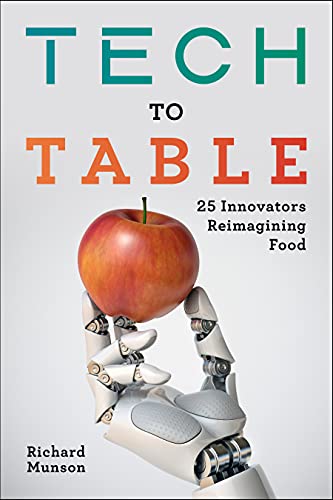
Tech to table : 25 innovators reimagining food / Richard Munson.
Material type: TextLanguage: English Publisher: Washington, DC : Island Press, 2021Description: xii, 282 pages : illustrations ; 24 cmContent type:
 - text
- unmediated
- volume
- 9781642831900 (hardcover)
- 1642831905 (hardcover)
- Food industry and trade -- Technological innovations
- Industrias alimenticias -- Innovaciones tecnológicas
- Ingeniería de alimentos
- Food engineers -- United States -- Biography
- Businesspeople -- United States -- Biography
- Empresarios -- Estados Unidos -- Biografías
- Inventors -- United States -- Biography
- Inventores -- Estados Unidos -- Biografías
- 664
- TP 370 M969t 2021
| Item type | Current library | Home library | Collection | Shelving location | Call number | Copy number | Status | Barcode | |
|---|---|---|---|---|---|---|---|---|---|
 Libro
Libro
|
Biblioteca Juan Bosch | Biblioteca Juan Bosch | Humanidades | Humanidades (4to. Piso) | TP 370 M969t 2021 (Browse shelf(Opens below)) | 1 | Available | 00000173317 |
Includes bibliographical references (pages 237-274) and index.
Introduction. The Rise of DisruptorsPart 1. Deliver ProteinsChapter 1. Josh Tetrick, JUST—Rethinking the Chicken and the EggChapter 2. Uma Valeti, Memphis Meats—Avoiding Animal SlaughterChapter 3. Patrick Brown, Impossible Foods—Making Burgers from PlantsChapter 4. James Corwell, Ocean Hugger Foods—Turning Tomatoes into TunaChapter 5. Virginia Emery, Beta Hatch—Farming InsectsChapter 6. Leonard Lerer, Back of the Yards Algae Sciences—Growing Algae and MyceliaPart 2. Reduce Food WasteChapter 7. Irving Fain, Bowery Farming—Bringing Crops Closer to ConsumersChapter 8. James Rogers and Jenny Du, Apeel Sciences—Coating FoodsChapter 9. Bob Pitzer, Harvest CROO—Picking Strawberries RoboticallyChapter 10. Raja Ramachandran, ripe.io—Tracking Food with BlockchainChapter 11. Lynette Kucma and Emilio Sepulveda, Foodini—Printing 3D MealsChapter 12. Daphna Nissenbaum, Tipa—Cutting Plastic PackagingPart 3. Curtail PoisonsChapter 13. Sebastian Boyer and Thomas Palomares, FarmWise—Plucking Weeds RoboticallyChapter 14. Jorge Heraud and Lee Redden, Blue River Technology—Spraying PreciselyChapter 15. Irina Borodina, BioPhero—Messing with Pest SexPart 4. Nourish PlantsChapter 16. Diane Wu and Poornima Paramswaran, Trace Genomics—Mapping SoilsChapter 17. Eric Taipale, Sentera—Analyzing Fields from AboveChapter 18. David Perry, Indigo Ag—Providing Probiotics to the SoilChapter 19. Karsten Temme and Alvin Tamsir, Pivot Bio—Feeding Nitrogen to Crop RootsChapter 20. Tony Alvarez, WaterBit—Watering PreciselyPart 5. Cut CarbonChapter 21. Rachel Haurwitz, Caribou Biosciences, and Federico Tripodi, Calyxt—Editing GenesChapter 22. Lee DeHaan, Land Institute—Planting PerennialsChapter 23. Joshua Goldman, Australis Aquaculture—Blocking BurpsChapter 24. Julia Collins, Planet FWD—Creating a Climate-Friendly Food PlatformChapter 25. Stafford Sheehan and Gregory Constantine, Air Co.—Cutting Carbon with VodkaConclusion. The Role of InnovationAcknowledgmentsNotesAbout the AuthorIndex
Imagine eating a burger grown in a laboratory, a strawberry picked by a robot, or a pastry created with a 3-D printer. You would never taste the difference, but these technologies might just save your health and the planet's. Today, landmark advances in computing, engineering, and medicine are driving solutions to the biggest problems created by industrialized food. Tech to Table introduces readers to twenty-five of the most creative entrepreneurs advancing these solutions. They come from various places and professions, identities and backgrounds. But they share an outsider's perspective and an idealistic, sometimes aggressive, ambition to rethink the food system. Reinvention is desperately needed. Under Big Ag, pollution, climate change, animal cruelty, hunger, and obesity have festered, and despite decades of effort, organic farming accounts for less than one percent of US croplands. Entrepreneurs represent a new path, one where disruptive technology helps people and the environment. These innovations include supplements to lower the methane in cattle belches, drones that monitor irrigation levels in crops, urban warehouses that grow produce year-round, and more. The pace and breadth of change is astonishing, as investors pump billions of dollars into ag-innovation. Startups are attracting capital and building markets, with the potential to upend conventional agribusiness's stranglehold on the food system. Not every invention will prosper long-term, but each marks a fundamental change in our approach to feeding a growing population--sustainably. A revolution in how we grow and eat food is brewing. Munson's deftly crafted profiles offer a fascinating preview of the coming future of food." -- Provided by publisher
There are no comments on this title.